帕斯卡│爸爸越禁我越愛!小時候居然被禁止學數學!斜槓數學家帕斯卡。【數學家故事】
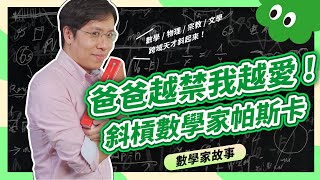
Blaise Pascal: The Cross-Disciplinary Genius Who Defied His Father to Study Math
This document provides a structured note based on the YouTube video "帕斯卡│爸爸越禁我越愛!小時候居然被禁止學數學!斜槓數學家帕斯卡。【數學家故事】" by 數感實驗室Numeracy Lab.
1. Summary
The video introduces Blaise Pascal, a remarkable Renaissance man known for his contributions to mathematics, physics, and philosophy. Despite his father's prohibition of mathematical studies in his youth, Pascal developed a profound interest and eventually became a leading figure in the field. The video explores the reasons behind his father's ban, Pascal's eventual defiance, and his diverse intellectual pursuits, including his invention of a calculating machine, his work on probability and pressure, and his philosophical reflections on faith, even attempting to mathematically analyze his own religious beliefs.
2. Key Takeaways
* **Cross-Disciplinary Genius:** Pascal was a polymath, excelling in mathematics, physics, philosophy, and invention.
* **Forbidden Fruit:** His father, despite being friends with mathematicians like Descartes, initially forbade Pascal from studying mathematics.
* **Early Fascination:** Pascal's innate curiosity led him to discover and pursue mathematics despite the ban.
* **Significant Contributions:** He developed Pascal's Triangle, invented the first mechanical calculator, and conducted groundbreaking experiments on atmospheric pressure.
* **Theology and Reason:** Pascal famously applied mathematical reasoning to questions of faith, resulting in his influential work, "Pensées" (Thoughts).
* **Legacy:** His work continues to influence various fields, from mathematics and probability to philosophy and computer science.
3. Detailed Notes
I. Introduction to Blaise Pascal
* **A Cross-Disciplinary Genius:** Described as a true "cross-domain genius" (跨域天才).
* **Key Accomplishments:**
* Researched air pressure.
* Developed the first mechanical calculator.
* Mediated disputes for gamblers (leading to probability theory).
* Used mathematics to analyze and decide on religious faith.
* **Prominence in Mathematics:** Appears in textbooks through concepts like "Pascal's Triangle" (帕斯卡三角形).
II. The Father's Prohibition: A Paradox
* **The Contradiction:** Pascal's father, Étienne Pascal, was himself fond of mathematics and had good relationships with prominent mathematicians like René Descartes and Marin Mersenne.
* **The Question:** Why would a father who loved math forbid his son from studying it?
* The video hints that this was a deliberate choice by his father, not a lack of opportunity.
* This prohibition fueled Pascal's curiosity and desire to learn.
III. Pascal's Journey into Mathematics
* **Defying the Ban:** Despite his father's restrictions, Pascal secretly engaged with mathematics.
* **Early Discoveries:**
* At a young age (around 11-12 years old), he independently discovered that the sum of angles in a triangle is 180 degrees.
* He later proved this theorem using geometric principles.
* **Father's Reaction:** Upon realizing his son's exceptional talent, his father relented and began teaching him mathematics.
IV. Major Contributions and Discoveries
* **Pascal's Triangle (Traité du triangle arithmétique):**
* A fundamental concept in combinatorics and algebra, laying groundwork for probability theory.
* The video mentions its appearance in math textbooks.
* **The First Mechanical Calculator (Pascaline):**
* Invented by Pascal in his early twenties to help his father with tax calculations.
* Considered one of the earliest mechanical calculators.
* **Pneumatics and Fluid Mechanics:**
* **Hydrostatic Paradox (or Pascal's Principle):** The pressure applied to an enclosed fluid is transmitted undiminished to every portion of the fluid and the walls of the containing vessel.
* **Atmospheric Pressure Experiments:**
* Replicated and extended the work of Evangelista Torricelli.
* Demonstrated that air has weight and that atmospheric pressure decreases with altitude.
* This was crucial for understanding weather and the vacuum.
* **Probability Theory:**
* His correspondence with Pierre de Fermat is considered the birth of probability theory.
* They analyzed problems related to gambling and games of chance.
* **Philosophy and Religion (Pensées and Lettres provinciales):**
* **"Pensées" (Thoughts):** A posthumously published collection of his philosophical fragments on faith, suffering, and human nature.
* **Pascal's Wager:** A famous argument that it is rational to believe in God, even without proof, because the potential reward (eternal salvation) outweighs the potential loss. He attempted to use probability and expected value to support his faith.
* **"Lettres provinciales" (Provincial Letters):** A series of anonymous letters criticizing the doctrines and practices of the Jesuits.
V. Pascal's Intellectual Struggle: Reason vs. Faith
* **The "Rational vs. Emotional Big Battle":** The video highlights Pascal's internal struggle to reconcile his scientific, rational mind with his deep religious convictions.
* **Mathematical Analysis of Faith:** He used his mathematical and logical skills to explore and justify his religious beliefs, famously exemplified by Pascal's Wager.
VI. Influential Connections
* **Marin Mersenne:** A monk and mathematician who fostered communication among scholars.
* **René Descartes:** A philosopher and mathematician, a contemporary of Pascal.
* **Pierre de Fermat:** A mathematician with whom Pascal developed probability theory.
VII. Conclusion
* Pascal's life is a testament to the power of curiosity and the pursuit of knowledge, even against formidable odds.
* His multifaceted genius left an indelible mark on science, mathematics, and philosophy, making him a pivotal figure in intellectual history.
Related Summaries
![[캡컷PC]0015-복합클립만들기분리된영상 하나로 만들기](https://img.youtube.com/vi/qtUfil0xjCs/mqdefault.jpg)

Why this video matters
This video provides valuable insights into the topic. Our AI summary attempts to capture the core message, but for the full nuance and context, we highly recommend watching the original video from the creator.
Disclaimer: This content is an AI-generated summary of a public YouTube video. The views and opinions expressed in the original video belong to the content creator. YouTube Note is not affiliated with the video creator or YouTube.