10-Minute Neuroscience: Action Potentials
10-Minute Neuroscience: Action Potentials - Notes
1. Summary
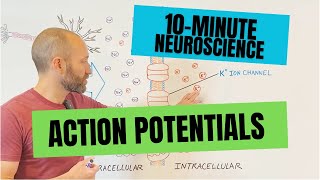
This video from "Neuroscientifically Challenged" provides a 10-minute overview of action potentials, the electrical impulses that travel along neurons, discussing the underlying mechanisms of action potential generation and propagation. The video explains the role of membrane potential, ion channels, and myelin in neuronal communication. It also covers the absolute and relative refractory periods, and their impact on repeated action potential firing, and is presented in a way that is accessible and entertaining.
2. Key Takeaways
* Action potentials are electrical impulses that travel along neurons, enabling communication within the nervous system.
* The resting membrane potential is established by the unequal distribution of ions, primarily sodium (Na+) and potassium (K+), maintained by ion channels and the sodium-potassium pump.
* An action potential is generated when the neuron reaches threshold potential, causing a rapid influx of Na+ followed by an outflow of K+.
* Myelin speeds up action potential propagation through saltatory conduction (jumping) at the Nodes of Ranvier.
* Absolute and relative refractory periods limit the rate at which a neuron can fire action potentials, affecting the relationship between stimulus intensity and firing frequency.
3. Detailed Notes
**Introduction (0:00 - 0:17)**
* Overview of action potentials (APs) - electrical impulses that transmit information in neurons.
* APs essential for neural communication and nervous system function.
**Membrane Potential (0:17 - 4:18)**
* **Cell Membrane:**
* Surrounds neuron and separates intracellular/extracellular environments.
* Environments filled with fluid and contain charged particles called ions.
* **Key Ions:**
* Sodium (Na+): More concentrated outside the neuron.
* Potassium (K+): More concentrated inside the neuron.
* **Ion Distribution:**
* Maintained by:
* Cell membrane (selective permeability)
* Ion channels:
* Specific to certain ions.
* Leak channels: Always open, allow some ion flow.
* Gated channels: Open in response to stimuli.
* Sodium-Potassium Pump:
* An enzyme that continuously pumps 3 Na+ ions out and 2 K+ ions into the cell.
* Maintains higher concentration of K+ inside, Na+ outside.
* Diffusion and electrostatic forces:
* Diffusion: Movement of ions from high to low concentration.
* Electrostatic forces: Like charges repel, opposites attract.
* **Resting Membrane Potential:**
* Difference in electrical charge between inside and outside of the cell.
* Typically -70 mV in resting neuron (inside 70 mV more negative than outside).
**Action Potential (4:18 - 7:20)**
* **Phases of an Action Potential:**
* Depolarization: Membrane potential moves towards zero, becoming less negative.
* Initiated by postsynaptic potentials.
* Threshold: If depolarization reaches a certain point, an action potential fires.
* Voltage-Gated Sodium Channels: Open in response to changes in voltage.
* Influx of Na+ into cell.
* Rapid change in membrane potential (rising phase).
* Potential becomes positive, up to +40 mV.
* How action potentials end:
* Voltage-Gated Sodium Channels: Begin to close.
* Voltage-Gated Potassium Channels: Open.
* Potassium flows out of the cell.
* Repolarization: Neuron returns to resting membrane potential.
* Sodium-Potassium Pump: Helps restore balance of Na+ and K+ inside and outside the cell.
* Process is rapid.
**Propagation Down the Axon and Role of Myelin (7:20 - 8:51)**
* Depolarization in one segment triggers depolarization in adjacent segments due to the high concentration of voltage-gated Na+ channels.
* **Myelin:**
* Insulating material that covers axons.
* Speeds up action potential propagation, reduces current leakage.
* **Nodes of Ranvier:** Gaps in myelin.
* Nodes of Ranvier are rich in voltage-gated sodium channels, so when a depolarizing action potential reaches a node of Ranvier, it causes another inrushing of sodium and a regeneration of the action potential.
* Saltatory Conduction: Action potential "jumps" between nodes.
**Absolute and Relative Refractory Periods (8:51 - 10:10)**
* **Absolute Refractory Period:**
* Voltage-gated sodium channels are unresponsive and cannot be activated immediately after an AP.
* Neuron cannot fire another AP during this period.
* **Relative Refractory Period:**
* Potassium channels close gradually, allowing enough potassium to flow out.
* Neuron is hyperpolarized.
* Sodium channels are transitioning back to active state.
* A strong stimulus is needed to produce another AP.
* **Impact:**
* Refractory periods make the rate of AP firing related to the intensity of stimulation.
* All-or-none law: Action potentials do not vary in size, but more intense stimuli cause more frequent firing.
Related Summaries
![[캡컷PC]0015-복합클립만들기분리된영상 하나로 만들기](https://img.youtube.com/vi/qtUfil0xjCs/mqdefault.jpg)

Why this video matters
This video provides valuable insights into the topic. Our AI summary attempts to capture the core message, but for the full nuance and context, we highly recommend watching the original video from the creator.
Disclaimer: This content is an AI-generated summary of a public YouTube video. The views and opinions expressed in the original video belong to the content creator. YouTube Note is not affiliated with the video creator or YouTube.