423 Years of American History in 13 Minutes
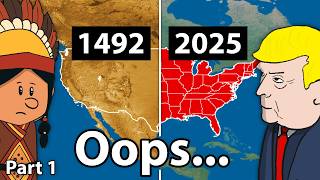
423 Years of American History in 13 Minutes: Notes
1. Summary
The video provides a simplified but historically accurate overview of the rise of the United States from its discovery by Christopher Columbus to its emergence as a world power just before World War I. It highlights key events in American history, emphasizing expansion, conflict, and the acquisition of territory, and explores the development of the US through colonization, revolution, expansion, and involvement in global politics.
2. Key Takeaways
* **From Ignorance to Dominance:** North America was largely ignored for over a century after Columbus's voyage, with the Spanish focused on Central and South America.
* **Early Colonization:** England established colonies in North America, with Jamestown becoming the first permanent settlement.
* **Conflict and Independence:** The French and Indian War led to British control, which in turn led to the American Revolution and the birth of the United States.
* **Westward Expansion:** The Louisiana Purchase, the Mexican-American War, and the Oregon Treaty significantly expanded American territory, fueled by the concept of Manifest Destiny.
* **Civil War:** The issue of slavery caused a devastating civil war, after which the US reunited as a nation, albeit with a profound and lasting impact on its history.
* **Global Power Emerges:** The Spanish-American War, the annexation of Hawaii, and the construction of the Panama Canal signaled America's rise as a global power, just prior to WWI.
3. Detailed Notes
**I. Introduction & Early Exploration (0:00 - 0:38)**
* The USA is the richest and most powerful country in history (26% of global GDP, 40% of global military spending).
* America's rise was "unexpected," as North America was initially ignored.
* Columbus's voyage: He sought a westward trade route to Asia for spices.
* He believed he found Asia (the Indies), and called the natives "Indians."
**II. Colonization and Early Conflicts (0:38 - 3:00)**
* Spain and Portugal drew a line dividing the non-Christian world.
* Portugal went to Asia, while Spain focused on the Americas.
* English exploration followed, though colonization was delayed.
* Early English colonies: Roanoke (failed) and Jamestown (successful).
* The Pilgrims and Plymouth.
* The French and Indian War (Seven Years' War): British vs. French (aided by Indian tribes).
* British win, gaining significant land, and France giving half of Louisiana to Spain.
**III. The Road to Revolution (3:00 - 4:18)**
* British war debt leads to increased taxes on the colonies.
* Colonial resentment and the cry of "No taxation without representation."
* Disagreement escalates into the American Revolution.
* The Declaration of Independence (July 4, 1776).
* The Articles of Confederation prove inadequate; a new government is needed.
* The Constitutional Convention creates a federal government.
**IV. Expansion and Manifest Destiny (4:18 - 5:58)**
* The Louisiana Purchase (1803) doubles the size of the USA, bought from Napoleon.
* Reasons for the Louisiana Purchase (Napoleon's need for funds, America's fear of French control of the Mississippi)
* The population doubles every 20 years.
* Westward movement & land claims.
* 1819, America bought Florida from Spain.
* Mexico's independence; American settlers in Texas outnumber Mexicans, leading to the Texas Revolution and the creation of an independent republic.
**V. Expansion and War (5:58 - 7:47)**
* Texas joins the USA (1845).
* Disputes over Texas's border lead to the Mexican-American War.
* Result: US gets the northern Mexican territories (California, Nevada, Utah, etc.)
* The Oregon Treaty (1846): US gains the Oregon Territory below the 49th parallel.
* Manifest Destiny: America expands from sea to sea.
* The Guano Islands Act allows the US to claim islands with bird droppings (for fertilizer).
**VI. Civil War and Reconstruction (7:47 - 9:22)**
* Discovery of gold in California & free farmland in Oregon draws settlers.
* Slavery becomes the central issue.
* Election of Abraham Lincoln (1860) precipitates the secession of Southern states.
* The American Civil War: North vs. South.
* The North wins, slavery is abolished, and the nation is reunited.
* The assassination of Lincoln.
**VII. Rise to Global Power (9:22 - 12:31)**
* The US purchases Alaska from Russia (1867) for $7 million.
* The US annexes Hawaii.
* The Spanish-American War (1898): US involvement in Cuba.
* The US defeats Spain and takes control of Cuba, Puerto Rico, and the Philippines.
* Theodore Roosevelt becomes president.
* The Panama Canal is constructed, allowing for easier movement between the Atlantic and Pacific oceans.
* America becomes a world power at the start of World War I.
Related Summaries
![[캡컷PC]0015-복합클립만들기분리된영상 하나로 만들기](https://img.youtube.com/vi/qtUfil0xjCs/mqdefault.jpg)

Why this video matters
This video provides valuable insights into the topic. Our AI summary attempts to capture the core message, but for the full nuance and context, we highly recommend watching the original video from the creator.
Disclaimer: This content is an AI-generated summary of a public YouTube video. The views and opinions expressed in the original video belong to the content creator. YouTube Note is not affiliated with the video creator or YouTube.