Basic Life Support
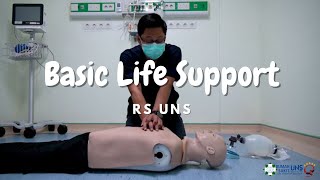
Basic Life Support (BLS) - Rumah Sakit UNS
**Presenter:** dr. Haqi (PPDS Anestesi)
---
1. Summary
This video provides a foundational overview of Basic Life Support (BLS), presented by dr. Haqi from the Anesthesiology Department of UNS Hospital. It covers the essential steps and principles of BLS, focusing on how to recognize a life-threatening emergency, initiate appropriate actions like cardiopulmonary resuscitation (CPR), and the importance of calling for professional medical help. The video aims to equip viewers with the basic knowledge and skills to respond effectively in emergency situations before advanced medical care arrives.
---
2. Key Takeaways
* **Recognize the Emergency:** Early identification of a cardiac arrest or life-threatening situation is crucial.
* **Call for Help:** Immediately contact emergency medical services (e.g., ambulance) after assessing the situation.
* **Chest Compressions are Key:** Effective chest compressions are the cornerstone of CPR, aiming to circulate blood.
* **CPR Technique:** Proper hand placement, depth, and rate of compressions are vital for efficacy.
* **Airway and Breathing:** Ensuring an open airway and providing rescue breaths (if trained and willing) complements compressions.
* **AED Usage:** Automated External Defibrillators (AEDs) are critical tools that can be used by lay rescuers to restart the heart.
* **Teamwork:** In a healthcare setting, BLS often involves a coordinated team effort.
* **Continuous Learning:** BLS skills require practice and regular updates.
---
3. Detailed Notes
**I. Introduction to Basic Life Support (BLS)**
* Definition: BLS refers to the initial medical care given for an acute illness or injury.
* Goal: To maintain life or prevent the condition from worsening until advanced medical help arrives.
* Presented by: KSM Anestesi, Rumah Sakit UNS, featuring dr. Haqi.
**II. Recognizing an Emergency**
* **Scene Safety:**
* Ensure the environment is safe for the rescuer and the victim before approaching.
* Check for hazards like traffic, fire, electrical wires, etc.
* **Assessing Responsiveness:**
* Gently tap the victim's shoulder and shout, "Are you okay?"
* Look for any response, movement, or sounds.
* **Checking for Breathing:**
* Look, listen, and feel for normal breathing for no more than 10 seconds.
* **Normal Breathing:** Chest rise and fall, regular sounds of breathing.
* **Agonal Gasps:** Irregular, shallow, gasping breaths; *these are NOT normal breathing and should be treated as a sign of cardiac arrest.*
**III. Activating Emergency Medical Services (EMS)**
* **The "Golden Minute":** Time is critical. Early activation of EMS significantly improves survival rates.
* **How to Call:**
* If alone and the victim is unresponsive and not breathing normally, call emergency services first.
* If there are other people present, delegate the task: "You, call XXX (emergency number) and get an AED if available!"
**IV. Cardiopulmonary Resuscitation (CPR)**
* **Purpose:** To manually circulate oxygenated blood to the brain and vital organs when the heart has stopped.
* **Key Components:** Chest compressions and rescue breaths.
* **A. Chest Compressions:**
* **Positioning:**
* Victim on a firm, flat surface.
* Rescuer kneeling beside the victim.
* Locate the center of the chest, on the lower half of the sternum (breastbone).
* **Hand Placement:**
* Place the heel of one hand on the sternum.
* Place the heel of the other hand on top of the first hand.
* Interlock fingers and keep them off the chest.
* **Technique:**
* Keep arms straight and shoulders directly over hands.
* Push hard and fast.
* **Depth:** At least 5 cm (2 inches) for adults.
* **Rate:** 100-120 compressions per minute (think of the beat of the song "Stayin' Alive").
* **Recoil:** Allow the chest to fully recoil between compressions.
* **Minimize Interruptions:** Aim for minimal pauses in compressions.
* **B. Airway Management:**
* **Head-Tilt/Chin-Lift Maneuver:**
* Place one hand on the victim's forehead and push down to tilt the head back.
* Place the fingers of the other hand under the bony part of the chin and lift the chin forward.
* This opens the airway by lifting the tongue away from the back of the throat.
* **C. Rescue Breaths (If trained and willing):**
* After 30 compressions, open the airway.
* Pinch the victim's nose shut.
* Take a normal breath and seal your mouth over the victim's mouth.
* Give one breath, lasting about 1 second, watching for chest rise.
* Allow the chest to fall, then give a second breath.
* **Ratio:** 30 compressions to 2 breaths.
* **Cycles:** Continue cycles of 30 compressions and 2 breaths.
**V. Use of Automated External Defibrillator (AED)**
* **What it is:** A portable device that can analyze the heart rhythm and deliver an electrical shock if needed to restore a normal rhythm.
* **When to Use:** As soon as an AED becomes available.
* **Steps:**
* Turn on the AED.
* Follow the voice and visual prompts.
* Attach the electrode pads to the victim's bare chest as indicated on the pads and the device.
* Ensure no one is touching the victim when the AED analyzes the rhythm and delivers a shock.
* Continue CPR after shock delivery as instructed by the AED.
**VI. Specific Considerations (Brief Mention)**
* **Team Approach:** In a hospital setting, BLS is often performed by a team, emphasizing clear communication and defined roles.
* **Pediatric BLS:** Different techniques and equipment may be used for infants and children. (Likely not detailed in this basic video).
**VII. Conclusion**
* BLS is a critical skill that can save lives.
* Regular training and practice are encouraged.
* The information provided is a basic overview and not a substitute for certified BLS training.
---
Related Summaries
![[캡컷PC]0015-복합클립만들기분리된영상 하나로 만들기](https://img.youtube.com/vi/qtUfil0xjCs/mqdefault.jpg)

Why this video matters
This video provides valuable insights into the topic. Our AI summary attempts to capture the core message, but for the full nuance and context, we highly recommend watching the original video from the creator.
Disclaimer: This content is an AI-generated summary of a public YouTube video. The views and opinions expressed in the original video belong to the content creator. YouTube Note is not affiliated with the video creator or YouTube.