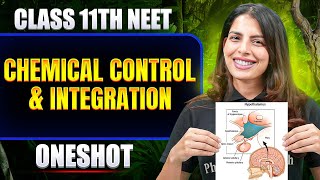
Chemical Control & Integration in ONE SHOT | All Concept & PYQ | Basic to Advance | Class 11 NEET
Here's a comprehensive and structured note based on the provided YouTube video information:
Chemical Control & Integration - Class 11 NEET (PW NEET)
Summary
This video provides a comprehensive, one-shot revision of the "Chemical Coordination and Integration" chapter for NEET Class 11. It covers the fundamental concepts of chemical coordination, the endocrine system, and the various endocrine glands and their hormones. The session progresses from basic to advanced topics, including detailed explanations of the hypothalamus, pituitary gland, thyroid, thymus, pineal gland, pancreas, adrenal gland, testes, and ovaries. It also discusses disorders related to these hormones, the nature of hormones, their mechanism of action, and concludes with a Question & Answer session featuring Previous Year Questions (PYQs).
Key Takeaways
* **Endocrine System:** A system of glands that secrete hormones directly into the bloodstream to regulate various bodily functions.
* **Hormones:** Chemical messengers that travel through the blood and act on target cells to elicit specific responses.
* **Hypothalamus:** The "master controller" of the endocrine system, regulating the pituitary gland.
* **Pituitary Gland:** Divided into anterior and posterior lobes, each secreting different hormones that control growth, metabolism, reproduction, and other vital functions.
* **Thyroid Gland:** Produces thyroxine (T4) and triiodothyronine (T3), crucial for metabolism and growth.
* **Pancreas:** Has both exocrine and endocrine functions, producing insulin and glucagon to regulate blood glucose levels.
* **Adrenal Glands:** Located on top of the kidneys, producing hormones like adrenaline, cortisol, and aldosterone that are vital for stress response, metabolism, and electrolyte balance.
* **Reproductive Hormones:** Testes (testosterone) and ovaries (estrogen, progesterone) are responsible for the development of secondary sexual characteristics and reproduction.
* **Hormone Action:** Hormones bind to specific receptors on target cells, triggering intracellular signaling pathways.
* **Disorders:** Understanding common endocrine disorders (e.g., gigantism, dwarfism, hypothyroidism, hyperthyroidism, diabetes mellitus) is crucial for NEET.
* **PYQs:** Practice of previous year questions is essential for mastering the concepts and exam preparation.
Detailed Notes
1. Introduction (00:00)
* Brief overview of the session's objective: to cover "Chemical Control and Integration" in one shot for NEET.
* Emphasis on covering all concepts from basic to advanced, including PYQs.
2. Chemical Coordination & Its Integration (02:14)
* **Need for Chemical Coordination:**
* Nervous system provides rapid, point-to-point coordination.
* Endocrine system provides slow, widespread, and long-lasting coordination.
* These systems integrate and coordinate their functions.
* **Endocrine Glands:** Ductless glands that secrete hormones directly into the bloodstream.
* **Hormones:**
* Chemical messengers.
* Produced in very small quantities.
* Transported by the blood.
* Act on specific target organs/tissues.
* Influence metabolic processes.
3. Hypothalamus (11:10)
* **Location:** Base of the forebrain.
* **Function:** Links the nervous system to the endocrine system.
* **Role in Regulating Pituitary:**
* Produces **releasing hormones** (e.g., GnRH, TRH, CRH, GHRH) that stimulate the anterior pituitary.
* Produces **inhibitory hormones** (e.g., somatostatin, PIH) that inhibit the anterior pituitary.
* Synthesizes hormones (ADH and Oxytocin) that are released by the posterior pituitary.
4. Pituitary Gland (43:21)
* **Location:** Attached to the hypothalamus by a stalk.
* **Lobes:**
* **Anterior Pituitary (Adenohypophysis):**
* **Growth Hormone (GH):** Stimulates growth and multiplication of cells.
* **Thyroid Stimulating Hormone (TSH):** Stimulates the thyroid gland.
* **Adrenocorticotropic Hormone (ACTH):** Stimulates the adrenal cortex.
* **Gonadotropins:**
* **Luteinizing Hormone (LH):** Stimulates ovulation and corpus luteum formation in females; stimulates testosterone production in males.
* **Follicle Stimulating Hormone (FSH):** Stimulates growth and development of ovarian follicles in females; stimulates spermatogenesis in males.
* **Prolactin (PRL):** Stimulates growth of mammary glands and milk production.
* **Melanocyte Stimulating Hormone (MSH):** Affects melanin dispersion in skin.
* **Posterior Pituitary (Neurohypophysis):**
* Stores and releases hormones synthesized by the hypothalamus.
* **Oxytocin:** Stimulates contraction of uterine muscles during childbirth and milk ejection from mammary glands.
* **Antidiuretic Hormone (ADH) / Vasopressin:** Stimulates reabsorption of water and electrolytes by the distal tubules and collecting ducts, reducing water loss.
5. Disorders of GH (01:01:19)
* **Gigantism:** Excess GH secretion during growth period.
* **Dwarfism:** Deficiency of GH secretion during growth period.
* **Acromegaly:** Excess GH secretion in adults, leading to enlargement of extremities and face.
6. Disorders of Thyroid Hormone (01:18:11)
* **Iodine Deficiency:**
* Enlargement of the thyroid gland (**Goiter**).
* Reduced synthesis of thyroid hormones.
* **Hypothyroidism:** Low levels of thyroid hormones.
* **In children:** Cretinism (stunted growth, mental retardation, impaired development).
* **In adults:** Myxedema (low metabolic rate, weight gain, puffy face, dry skin).
7. Hyperthyroidism (01:25:04)
* **Graves' Disease:** An autoimmune disorder causing excessive thyroid hormone production.
* **Symptoms:** Increased metabolic rate, weight loss, rapid heartbeat, bulging eyes (exophthalmos).
8. Thymus & Pineal Gland & Pancreas (01:35:14)
* **Thymus Gland:**
* Located behind the sternum.
* Secretes **Thymosin**.
* **Thymosin:** Plays a role in the differentiation of T-lymphocytes, crucial for cell-mediated immunity. Degenerates in old age.
* **Pineal Gland:**
* Located on the dorsal side of the forebrain.
* Secretes **Melatonin**.
* **Melatonin:** Regulates the 24-hour diurnal rhythm (sleep-wake cycle), body temperature, and influences metabolism and pigmentation.
* **Pancreas:**
* Located between the limbs of the 'C'-shaped duodenum.
* **Dual Gland:**
* **Exocrine Part:** Digestive enzymes.
* **Endocrine Part (Islets of Langerhans):**
* **Alpha cells:** Secrete **Glucagon**.
* **Beta cells:** Secrete **Insulin**.
* **Insulin:** Lowers blood glucose levels by promoting glucose uptake by cells and glycogen synthesis in liver and muscles.
* **Glucagon:** Raises blood glucose levels by stimulating glycogenolysis and gluconeogenesis in the liver.
9. Insulin & Adrenal Gland (Adrenal Cortex Hormones) (01:48:24)
* **Disorders of Insulin:**
* **Diabetes Mellitus:** Deficiency or improper utilization of insulin, leading to high blood glucose levels.
* **Adrenal Gland:**
* Paired glands located on the anterior part of each kidney.
* **Adrenal Medulla:** Secretes **Adrenaline (Epinephrine)** and **Noradrenaline (Norepinephrine)** - "Emergency hormones" or "Fight-or-Flight" hormones.
* Increase heart rate, blood pressure, respiration rate, blood glucose.
* **Adrenal Cortex:** Divided into three zones (from outside to inside):
* **Zona Glomerulosa:** Secretes **Mineralocorticoids** (e.g., Aldosterone). Regulates water and electrolyte balance, blood pressure.
* **Zona Fasciculata:** Secretes **Glucocorticoids** (e.g., Cortisol). Regulates carbohydrate, protein, and fat metabolism, immune response, and inhibits inflammation.
* **Zona Reticularis:** Secretes **Adrenal Androgens**. Contribute to secondary sexual characteristics.
10. Testis & Ovary (02:13:02)
* **Testis (Male):**
* Primary sex organ.
* Produces **Testosterone** (an androgen).
* **Functions:** Development of secondary sexual characters, spermatogenesis, influences male sexual behavior.
* **Ovary (Female):**
* Primary sex organ.
* Produces **Estrogen** and **Progesterone**.
* **Estrogen:** Development of secondary sexual characters, regulation of menstrual cycle.
* **Progesterone:** Supports pregnancy, development of mammary glands.
11. Hormones of Other Organs (02:27:29)
* **Heart:** Atrial Natriuretic Factor (ANF) - Lowers blood pressure.
* **Kidney:** Erythropoietin (EPO) - Stimulates RBC production.
* **Gastrointestinal Tract:** Several hormones regulating digestion (e.g., Gastrin, Secretin, Cholecystokinin (CCK), Gastric Inhibitory Peptide (GIP)).
* **Placenta:** Estrogen, Progesterone, hCG, hPL (during pregnancy).
12. Nature of Hormones & Mechanism of Hormone Action (02:38:35)
* **Nature of Hormones:**
* Peptide hormones (e.g., insulin, glucagon, pituitary hormones).
* Steroid hormones (e.g., cortisol, estrogen, testosterone).
* Amino acid derivatives (e.g., adrenaline, thyroxine).
* **Mechanism of Hormone Action:**
* **Hormone Receptor Complexes:** Hormones bind to specific receptors, either on the cell surface or intracellularly.
* **Cellular Responses:** This binding triggers a cascade of events leading to a specific cellular response.
* **Peptide/Amino acid derivative hormones:** Generally bind to cell-surface receptors, initiating second messenger pathways (e.g., cAMP).
* **Steroid hormones & Thyroid hormones:** Are lipid-soluble and pass through the cell membrane to bind to intracellular receptors (cytoplasmic or nuclear), influencing gene expression.
13. Questions (02:52:40)
* Discussion and solving of Previous Year Questions (PYQs) related to the chapter.
14. Thank you (03:00:10)
* Concluding remarks and encouragement.
Related Summaries
![[캡컷PC]0015-복합클립만들기분리된영상 하나로 만들기](https://img.youtube.com/vi/qtUfil0xjCs/mqdefault.jpg)

Why this video matters
This video provides valuable insights into the topic. Our AI summary attempts to capture the core message, but for the full nuance and context, we highly recommend watching the original video from the creator.
Disclaimer: This content is an AI-generated summary of a public YouTube video. The views and opinions expressed in the original video belong to the content creator. YouTube Note is not affiliated with the video creator or YouTube.