Complete Economy Revision Marathon for UPSC Prelims 2026 with Current Updates, PYQs, MAD
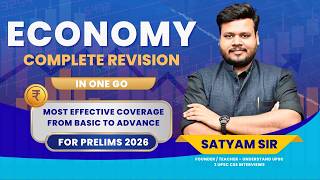
UPSC Prelims 2026 Economy Revision Marathon - Comprehensive Notes
**Video Title:** Complete Economy Revision Marathon for UPSC Prelims 2026 with Current Updates, PYQs, MAD
**Channel:** UnderStand UPSC
**Duration:** 27 Hours
---
1. Summary
This 27-hour revision marathon by UnderStand UPSC is designed as a comprehensive, exam-oriented program for UPSC CSE Prelims 2026 aspirants. It aims to provide complete conceptual clarity, integrate static and current affairs, link to Previous Year Questions (PYQs), and offer a high-yield revision of the entire Indian Economy syllabus. The marathon covers everything from basic economic concepts to advanced topics, aligned with current UPSC trends and question patterns, focusing on conceptual understanding for elimination techniques and high-probability areas. It is presented as a one-stop solution for serious aspirants seeking to strengthen their foundation and boost their score in the often unpredictable, yet high-scoring, Economy section.
---
2. Key Takeaways
* **Comprehensive Coverage:** Covers the entire Indian Economy syllabus for UPSC Prelims 2026.
* **Structured & Exam-Oriented:** Designed for serious aspirants with a focus on conceptual clarity and exam patterns.
* **Static + Current Integration:** Seamlessly blends static economic concepts with relevant current affairs.
* **PYQ Focus:** Emphasizes Previous Year Question (PYQ) linkage and trend analysis.
* **Conceptual Clarity:** Aims to build strong foundational understanding crucial for elimination techniques in MCQs.
* **High-Yield Revision:** Focuses on high-probability areas and essential definitions for retention.
* **One-Stop Solution:** Acts as a complete, one-shot revision for the Indian Economy section.
* **Target Audience:** Primarily for UPSC Prelims 2026 aspirants, but also beneficial for early starters (2027), repeaters, and those struggling with specific concepts.
* **Resource:** PDF of the PPT and notes is available via the provided Telegram link.
---
3. Detailed Notes
This section outlines the key areas and pedagogical approach covered in the 27-hour marathon.
**I. Core Philosophy & Approach**
* **Exam-Oriented:** Strict alignment with latest UPSC trends and question patterns.
* **Conceptual Clarity:** Focus on understanding "why" and "how" to enable elimination techniques.
* **Static + Current Integration:** Bridging the gap between foundational knowledge and contemporary economic issues.
* **PYQ Linkage:** Using PYQs to understand question framing, difficulty level, and recurring themes.
* **Revision Focused:** Structured for effective retention and last-minute preparation.
* **Beyond Surface Level:** Covers basics to advanced topics with depth.
**II. Syllabus Coverage - Key Topics**
* **A. Macroeconomic Fundamentals:**
* **National Income Accounting:** GDP, GNP, NNP, GDP Deflator, Per Capita Income.
* **Inflation:** Types of inflation, causes, effects, measurement (CPI, WPI), demand-pull vs. cost-push.
* **Economic Growth vs. Development:** Definitions, indicators, drivers.
* **Poverty:** Definitions, measurement (e.g., Tendulkar, Rangarajan committees), causes, government initiatives.
* **Unemployment:** Types of unemployment, causes, measurement, government policies.
* **B. Money, Banking & Financial System:**
* **Money:** Functions, evolution, types, measures of money supply (M1, M2, M3, M4).
* **Banking System:** Commercial banks, public sector banks, private banks, cooperative banks.
* **Reserve Bank of India (RBI):** Functions (monetary authority, regulator, issuer of currency), monetary policy tools.
* **Credit Creation:** Process and limitations.
* **Non-Banking Financial Companies (NBFCs):** Role and regulation.
* **C. Monetary Policy:**
* **Objectives:** Price stability, growth, employment, etc.
* **Tools:**
* **Quantitative:** CRR, SLR, Repo Rate, Reverse Repo Rate, Bank Rate, Open Market Operations (OMOs).
* **Qualitative:** Selective Credit Control, Moral Suasion.
* **Monetary Policy Committee (MPC):** Composition, functions, inflation targeting.
* **D. Fiscal Policy:**
* **Government Budget:** Concepts (revenue receipts, capital receipts, revenue expenditure, capital expenditure), types of budgets (balanced, surplus, deficit).
* **Fiscal Deficit:** Definition, measurement, implications.
* **Revenue Deficit & Primary Deficit.**
* **Public Debt:** Types and management.
* **Taxation:** Direct vs. Indirect taxes, progressive vs. regressive taxes, Goods and Services Tax (GST).
* **Subsidies:** Types, rationale, fiscal implications.
* **Fiscal Responsibility and Budget Management (FRBM) Act:** Objectives and evolution.
* **E. External Sector:**
* **Balance of Payments (BoP):** Current Account, Capital Account, Foreign Exchange Reserves.
* **Exchange Rate:** Determination, types (fixed, flexible, managed float), appreciation vs. depreciation.
* **Foreign Trade:** Trade deficit, trade surplus, India's trade partners, major exports/imports.
* **Foreign Direct Investment (FDI):** Concepts, sectors, policy.
* **Foreign Portfolio Investment (FPI):** Concepts, differences from FDI.
* **International Financial Institutions:** IMF, World Bank, WTO (briefly, in context of trade).
* **F. Indian Economy - Sectoral Aspects:**
* **Agriculture:**
* Land reforms, Green Revolution, agricultural productivity.
* **Minimum Support Price (MSP):** Concepts, determination, challenges.
* Agricultural marketing, supply chains.
* Government schemes related to agriculture.
* **Industry:** Industrial policy, MSMEs, major industrial sectors.
* **Services Sector:** Role and growth.
* **G. Economic Survey & Budget:**
* **Key Highlights:** Major themes, data points, and policy announcements relevant for Prelims 2026.
* **Data Interpretation:** Understanding key economic indicators presented in these documents.
* **H. Infrastructure & Growth:**
* **Infrastructure Development:** Importance, sectors (transport, energy, communication).
* **Growth Models:** Basic understanding.
* **I. Financial Markets:**
* **Money Market:** Instruments, institutions.
* **Capital Market:**
* **Primary Market:** IPOs, FPOs.
* **Secondary Market:** Stock exchanges (NSE, BSE), trading mechanisms.
* **Securities and Exchange Board of India (SEBI):** Role and functions.
* **Bonds:** Types, features, yield.
* **J. Index-Based & Data-Based Concepts:**
* Understanding and interpreting various economic indices (e.g., CPI, WPI, Human Development Index - HDI, ease of doing business index etc.).
* Crucial economic data points and their significance.
**III. Pedagogy & Revision Strategy**
* **Conceptual Clarity for Elimination:** Explanations designed to help candidates differentiate between similar options in MCQs.
* **PYQ-Based Reinforcement:** Every topic is linked to relevant PYQs to showcase application and expected patterns.
* **Prelims-Oriented Framing:** Content is presented with a direct focus on what is asked in the Prelims exam.
* **Important Definitions & Terminology:** Emphasis on precise understanding of key economic terms.
* **High-Probability Question Areas:** Focus on topics that have historically appeared frequently or are expected to be important.
* **Revision-Focused Structuring:** Information is organized for better retention and recall.
* **MAD (Most Expected Areas):** Identification and focused discussion on the most probable questions for Prelims 2026.
**IV. Why This Video is Crucial**
* **Unpredictable yet High-Scoring:** Economy demands a strong conceptual base and current awareness.
* **Conceptual & Application-Based Questions:** Need for understanding beyond rote learning.
* **Strengthen Core Concepts:** Building a solid foundation.
* **Improve Elimination Skills:** Essential for tackling tricky MCQs.
* **Integrate Key Documents:** Seamlessly incorporates Economic Survey and Budget insights.
* **Avoid Common Mistakes:** Addressing prevalent misconceptions.
* **Boost Confidence:** Providing a sense of preparedness.
**V. Who Should Watch**
* UPSC Prelims 2026 aspirants (primary).
* UPSC 2027 early starters.
* Repeaters struggling with the Economy section.
* Students confused about macroeconomics and monetary policy.
* Aspirants scoring low in Economy mock tests.
* Serious candidates seeking a comprehensive, structured syllabus revision.
---
**(Note: The actual 27-hour video would elaborate on each of these points with detailed explanations, examples, diagrams, and discussions on PYQs. This note serves as a structured summary of the video's content and intent.)**
Related Summaries
![[캡컷PC]0015-복합클립만들기분리된영상 하나로 만들기](https://img.youtube.com/vi/qtUfil0xjCs/mqdefault.jpg)
Why this video matters
This video provides valuable insights into the topic. Our AI summary attempts to capture the core message, but for the full nuance and context, we highly recommend watching the original video from the creator.
Disclaimer: This content is an AI-generated summary of a public YouTube video. The views and opinions expressed in the original video belong to the content creator. YouTube Note is not affiliated with the video creator or YouTube.