Complete Software Engineering in one shot | Semester Exam | Hindi
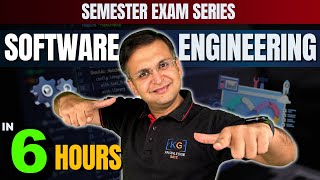
Software Engineering - Complete in One Shot (KnowledgeGATE by Sanchit Sir)
Summary
This comprehensive "one-shot" video by KnowledgeGATE by Sanchit Sir provides a detailed overview of Software Engineering, ideal for university semester exams. It covers the entire Software Development Life Cycle (SDLC), from an introduction to the field and its characteristics, through requirement specification, design, testing, and finally, maintenance and project management. The video emphasizes key concepts, models, techniques, and standards relevant to the software engineering discipline, aiming to equip students with a strong understanding for their examinations.
Key Takeaways
* **Software Engineering Fundamentals:** Understand the definition, characteristics, and crisis in software development, and how software engineering aims to address these.
* **SDLC Models:** Grasp the core principles and differences of various Software Development Life Cycle models like Waterfall, Prototype, Spiral, Evolutionary, and Iterative Enhancement.
* **Requirement Engineering:** Learn the process of gathering, analyzing, documenting, and managing user needs, including feasibility studies and modeling techniques (DFD, ERD).
* **Software Quality Assurance (SQA):** Understand verification, validation, SQA plans, and quality frameworks like ISO 9000 and SEI-CMM.
* **Software Design:** Differentiate between architectural and low-level design, explore modularization, coupling, cohesion, and design strategies (Function-Oriented, Object-Oriented, Top-Down, Bottom-Up).
* **Software Metrics:** Familiarize yourself with metrics for measuring software size and complexity, such as Halstead's, Function Point, and Cyclomatic Complexity.
* **Software Testing:** Understand various testing levels (Unit, Integration, Acceptance, Regression) and types (Functional, Performance, Structural/White Box, Functional/Black Box), including Alpha and Beta testing.
* **Static Testing:** Learn about review techniques like Formal Technical Reviews, Walkthroughs, and Code Inspections.
* **Software Maintenance:** Understand the reasons for maintenance, its categories (Preventive, Corrective, Perfective), and concepts like re-engineering and reverse engineering.
* **Software Project Management:** Cover estimation techniques (COCOMO), resource allocation, risk analysis, and the importance of Software Configuration Management (SCM).
Detailed Notes
Chapter-0: About this video (00:00)
* Introduction to the video's purpose: a comprehensive coverage of Software Engineering for semester exams.
* Links and contact information for KnowledgeGate resources (website, WhatsApp, Telegram, email).
* Playlist for GATE CSE one-shot videos and specific semester exam one-shot videos.
Chapter-1: Introduction (02:54)
* **Introduction to Software Engineering:**
* Definition: Application of engineering principles to the development of software.
* **Software Components:** Programs, data structures, documentation.
* **Software Characteristics:**
* Reliability: Performs its intended function without failure.
* Usability: Easy to learn and operate.
* Efficiency: Uses system resources optimally.
* Maintainability: Easy to modify and fix.
* Portability: Can be transferred to different environments.
* Reusability: Parts of the software can be used in other projects.
* Testability: Easy to test.
* Understandability: Source code is clear.
* **Software Crisis:** Problems faced in software development like cost overruns, schedule delays, poor quality, and difficulty in maintenance.
* **Software Engineering Processes:** A systematic, disciplined, and quantifiable approach to software development.
* **Similarity and Differences from Conventional Engineering Processes:**
* **Similarities:** Planning, design, implementation, testing, maintenance, project management.
* **Differences:** Software is intangible, easily replicated, and its requirements can change rapidly.
* **Software Quality Attributes:** (Elaborated in detail later in the video, but introduced here) - Correctness, reliability, efficiency, usability, maintainability, etc.
* **Software Development Life Cycle (SDLC) Models:**
* **Waterfall Model:**
* Sequential phases: Requirements, Design, Implementation, Testing, Deployment, Maintenance.
* Pros: Simple, easy to manage.
* Cons: Inflexible, difficult to handle changes, testing only at the end.
* **Prototype Model:**
* Create a working model (prototype) early for user feedback.
* Phases: Requirements, Design, Prototype Construction, User Evaluation, Refinement, Final Product.
* Pros: Good for understanding user needs, reduces risk of unmet requirements.
* Cons: Can be costly, users might mistake prototype for final product.
* **Spiral Model:**
* Combines Waterfall and Prototyping with risk analysis.
* Phases in cycles: Planning, Risk Analysis, Engineering, Customer Evaluation.
* Pros: Handles risks, suitable for large and complex projects.
* Cons: Complex, requires risk assessment expertise.
* **Evolutionary Development Models:**
* Software is developed in increments, with each increment building upon the previous one.
* Examples: Incremental Model, Iterative Model.
* **Iterative Enhancement Models:**
* Starts with a small, working version and gradually adds functionality in iterations.
Chapter-2: Software Requirement Specifications (SRS) (1:32:15)
* **Requirement Engineering Process:**
* **Elicitation:** Gathering requirements from stakeholders (interviews, questionnaires, workshops).
* **Analysis:** Understanding, structuring, and prioritizing requirements.
* **Documentation:** Writing down the requirements in a clear and unambiguous manner.
* **Review:** Verifying the documented requirements with stakeholders.
* **Management:** Handling changes and updates to requirements throughout the lifecycle.
* **Feasibility Study:** Assessing the technical, economic, and operational viability of a project.
* **Information Modeling:** Representing the structure of data and relationships.
* **Data Flow Diagrams (DFD):** Visual representation of data flow within a system.
* Components: Processes, Data Stores, External Entities, Data Flows.
* Levels: Level 0 (Context Diagram), Level 1, Level 2, etc.
* **Entity Relationship Diagrams (ERD):** Visual representation of entities and their relationships in a database.
* Components: Entities, Attributes, Relationships (one-to-one, one-to-many, many-to-many).
* **Decision Tables:** Tabular method to represent complex business rules and their outcomes.
* **SRS Document:**
* **Purpose:** A formal document describing what the software will do.
* **Contents:** Introduction, overall description, specific requirements (functional, non-functional).
* **IEEE Standards for SRS:** Standards like IEEE 830 provide guidelines for SRS structure and content.
* **Software Quality Assurance (SQA):**
* **Verification:** Are we building the product right? (Checking against specifications).
* **Validation:** Are we building the right product? (Checking if it meets user needs).
* **SQA Plans:** Document outlining quality objectives and activities.
* **Software Quality Frameworks:**
* **ISO 9000 Models:** International standards for quality management systems.
* **SEI-CMM (Capability Maturity Model):** A framework for assessing and improving software development processes.
* Levels: Initial, Repeatable, Defined, Managed, Optimizing.
Chapter-3: Software Design (2:45:25)
* **Basic Concept of Software Design:**
* Transforming requirements into a detailed blueprint for implementation.
* Focuses on *how* the system will be built.
* **Architectural Design:** High-level design of the system's structure, components, and their relationships.
* Defines the overall organization of the software.
* **Low Level Design (Detailed Design):** Design of individual modules and their internal logic.
* **Modularization:** Breaking down the system into smaller, independent modules.
* **Design Structure Charts:** Hierarchical representation of modules and their interactions.
* **Pseudo Codes:** High-level description of an algorithm's logic, not actual code.
* **Flow Charts:** Graphical representation of the steps and decisions in an algorithm.
* **Coupling and Cohesion Measures:**
* **Coupling:** Degree of interdependence between modules (lower is better). Types: Content, Common, Control, Stamp, Data, Message, No coupling.
* **Cohesion:** Degree to which elements within a module belong together (higher is better). Types: Coincidental, Logical, Temporal, Procedural, Communicational, Sequential, Functional.
* **Design Strategies:**
* **Function Oriented Design:** Focuses on decomposing the system into a set of functions or procedures.
* **Object Oriented Design (OOD):** Focuses on objects, their attributes, and behaviors. Key concepts: Encapsulation, Inheritance, Polymorphism.
* **Top-Down Design:** Starts with the main system and breaks it down into smaller sub-systems.
* **Bottom-Up Design:** Starts with individual components and builds them up into larger systems.
* **Software Measurement and Metrics:**
* **Various Size Oriented Measures:**
* **Halstead's Software Science:** Mathematical theory to predict software attributes based on operators and operands.
* Measures: Vocabulary (n), Length (N), Halstead's Volume (V), Difficulty (D), Effort (E).
* **Function Point (FP) Based Measures:** Estimates software size based on the number of input, output, inquiry, internal logical files, and external interface files.
* **Cyclomatic Complexity Measures:**
* **Control Flow Graphs (CFG):** Graphical representation of the flow of control in a program.
* **Cyclomatic Complexity:** A quantitative measure of the complexity of a program. Calculated as E - N + 2P (Edges - Nodes + 2 * Connected Components). Higher complexity indicates more test cases are needed.
Chapter-4: Software Testing (4:36:15)
* **Testing Objectives:**
* Find defects.
* Ensure quality.
* Verify requirements.
* Build confidence.
* **Testing Levels:**
* **Unit Testing:** Testing individual modules or components in isolation.
* **Integration Testing:** Testing the interaction between integrated modules.
* **Acceptance Testing:** Testing by the end-user or client to ensure the system meets their needs.
* **Regression Testing:** Re-testing previously tested parts of the software after changes to ensure no new defects were introduced.
* **Testing for Functionality and Testing for Performance:**
* **Functional Testing:** Verifying that the software performs its intended functions.
* **Performance Testing:** Assessing the responsiveness, stability, and resource usage of the software.
* **Top-Down and Bottom-Up Testing Strategies:**
* **Test Drivers:** (Used in Bottom-Up) A module that calls a module under test.
* **Test Stubs:** (Used in Top-Down) A module that simulates a called module.
* **Structural Testing (White Box Testing):** Testing the internal structure, code, and logic of the software. Based on knowledge of the code.
* **Functional Testing (Black Box Testing):** Testing the functionality of the software without knowledge of its internal structure. Based on specifications.
* **Test Data Suit Preparation:** Creating input data and expected outputs for testing.
* **Alpha and Beta Testing of Products:**
* **Alpha Testing:** Internal testing by developers or an independent testing team within the organization.
* **Beta Testing:** External testing by a select group of users in their environment.
* **Static Testing Strategies:** Testing without executing the code.
* **Formal Technical Reviews (Peer Reviews):** A systematic evaluation of software artifacts (code, design documents, etc.) by peers.
* **Walk Through:** A presentation of a software artifact by its creator to reviewers.
* **Code Inspection:** A formal, structured peer review of source code.
* **Compliance with Design and Coding Standards:** Ensuring the software adheres to established guidelines.
Chapter-5: Software Maintenance and Software Project Management (5:28:30)
* **Software as an Evolutionary Entity:** Software needs to change over time due to evolving requirements, bug fixes, and performance improvements.
* **Need for Maintenance:**
* Correcting errors.
* Adapting to changes in the environment.
* Improving performance or maintainability.
* **Categories of Maintenance:**
* **Preventive Maintenance:** Changes to improve future maintainability and prevent future problems.
* **Corrective Maintenance:** Fixing defects found after release.
* **Perfective Maintenance:** Enhancing functionality or performance based on user requests.
* **Adaptive Maintenance:** Modifying software to adapt to changes in its external environment (e.g., new OS, hardware).
* **Cost of Maintenance:** Often higher than development cost.
* **Software Re-Engineering:** Redesigning and re-implementing existing software to improve its quality and maintainability.
* **Reverse Engineering:** Analyzing existing software to understand its design and functionality.
* **Software Configuration Management (SCM):**
* **Activities:** Version control, change control, configuration auditing, status reporting.
* **Change Control Process:** Formal process for managing changes to software.
* **Software Version Control:** Managing different versions of software artifacts.
* **An Overview of CASE Tools (Computer-Aided Software Engineering):** Tools that support various software engineering activities (e.g., design tools, testing tools).
* **Estimation of Various Parameters:**
* **Cost, Efforts, Schedule/Duration:** Estimating resources and time required for a project.
* **Constructive Cost Models (COCOMO):** A widely used algorithmic model for software cost estimation.
* Types: Basic COCOMO, Intermediate COCOMO, Detailed COCOMO.
* **Resource Allocation Models:** Planning and assigning resources (people, hardware, software) to tasks.
* **Software Risk Analysis and Management:**
* **Risk Identification:** Identifying potential problems.
* **Risk Analysis:** Assessing the probability and impact of risks.
* **Risk Mitigation:** Planning strategies to reduce or avoid risks.
* **Risk Monitoring:** Tracking identified risks.
Related Summaries
![[캡컷PC]0015-복합클립만들기분리된영상 하나로 만들기](https://img.youtube.com/vi/qtUfil0xjCs/mqdefault.jpg)
Why this video matters
This video provides valuable insights into the topic. Our AI summary attempts to capture the core message, but for the full nuance and context, we highly recommend watching the original video from the creator.
Disclaimer: This content is an AI-generated summary of a public YouTube video. The views and opinions expressed in the original video belong to the content creator. YouTube Note is not affiliated with the video creator or YouTube.