Concepts of Bayesian Inference - Chapter 1 - part 1
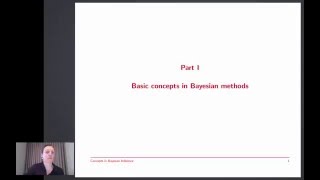
Concepts of Bayesian Inference - Chapter 1 - Part 1
**Channel:** Christel FAES
---
1. Summary
This video introduces the fundamental concepts of Bayesian inference, focusing on its core components and philosophical underpinnings. It begins by defining probability as a degree of belief, distinguishing it from the frequentist interpretation. The presenter then delves into the mathematical representation of these beliefs using probability distributions, particularly the **prior distribution** (representing initial beliefs) and the **likelihood function** (representing the probability of observing data given a hypothesis). The central idea of Bayesian inference is then presented: updating prior beliefs with observed data to arrive at a **posterior distribution**, which represents updated beliefs. The video emphasizes the iterative nature of this process and hints at the computational challenges involved, setting the stage for future discussions on practical implementation.
---
2. Key Takeaways
* **Probability as Degree of Belief:** Bayesian inference views probability not as the long-run frequency of an event, but as a subjective measure of how likely an event is to occur, or how convinced one is of a statement's truth.
* **Prior Distribution ($P(\theta)$):** This represents our initial beliefs about unknown parameters or hypotheses *before* observing any data. It can be based on prior knowledge, expert opinion, or even a state of ignorance.
* **Likelihood Function ($P(y|\theta)$):** This quantifies the probability of observing the data ($y$) given a specific value of the unknown parameter or hypothesis ($\theta$). It tells us how well a particular parameter value explains the observed data.
* **Posterior Distribution ($P(\theta|y)$):** This is the updated belief about the unknown parameter or hypothesis *after* observing the data. It is the result of combining the prior beliefs with the information from the data via Bayes' theorem.
* **Bayes' Theorem as the Core Mechanism:** The entire process of Bayesian inference is governed by Bayes' theorem, which formally describes how to update beliefs.
* **Iterative Nature:** Bayesian inference is an iterative process. The posterior distribution from one analysis can serve as the prior distribution for a subsequent analysis when new data becomes available.
* **The Role of Data:** Data plays a crucial role in "pulling" the prior towards a posterior that is more consistent with the evidence.
* **Distinction from Frequentist Inference:** Bayesian inference focuses on updating beliefs about parameters, treating them as random variables, whereas frequentist inference often focuses on the probability of observing the data given a fixed, but unknown, parameter.
---
3. Detailed Notes
#### 1.1.1 - Introduction to Bayesian Inference (02:47)
* **What is Bayesian Inference?**
* A framework for updating our beliefs about unknown quantities (parameters, hypotheses) in light of new evidence (data).
* It's a formal way of combining what we already believe with what we observe.
* **Probability as Degree of Belief:**
* This is a key philosophical difference from frequentist statistics.
* Probability represents a subjective measure of certainty or conviction.
* Examples:
* The probability that it will rain tomorrow.
* The probability that a specific medical treatment is effective.
* The probability that a particular hypothesis is true.
* **The Unknown is Treated as Random:** In Bayesian inference, unknown parameters are treated as random variables, meaning they have probability distributions.
#### 1.1.2 - The Components of Bayesian Inference (09:09)
* **The Goal:** To learn about some unknown quantity, let's call it $\theta$. $\theta$ can be a single value or a set of values.
* **Prior Distribution ($P(\theta)$):**
* Represents our beliefs about $\theta$ *before* seeing any data.
* It's a probability distribution over the possible values of $\theta$.
* Can be:
* **Informative:** Based on strong prior knowledge or previous studies.
* **Uninformative/Weakly Informative:** Reflects a state of relative ignorance about $\theta$, allowing the data to speak more strongly.
* **Likelihood Function ($P(y|\theta)$):**
* Represents the probability of observing the data ($y$) *given* a specific value of $\theta$.
* It's a function of the data, but it's parameterized by $\theta$.
* Crucially, it is *not* a probability distribution over $\theta$. It tells us how likely the data is for different values of $\theta$.
* **Posterior Distribution ($P(\theta|y)$):**
* Represents our updated beliefs about $\theta$ *after* observing the data ($y$).
* It is the result of combining the prior and the likelihood.
* It's also a probability distribution over $\theta$.
#### 1.1.3 - Bayes' Theorem (21:38)
* **The Mathematical Formula:**
$$P(\theta|y) = \frac{P(y|\theta) P(\theta)}{P(y)}$$
* **$P(\theta|y)$:** Posterior probability (what we want to compute).
* **$P(y|\theta)$:** Likelihood of the data given the parameter.
* **$P(\theta)$:** Prior probability of the parameter.
* **$P(y)$:** Marginal likelihood (or evidence). It's the probability of the data averaged over all possible values of $\theta$.
$$P(y) = \int P(y|\theta) P(\theta) d\theta$$
(This integral can be a sum if $\theta$ is discrete).
* **Interpretation:** Bayes' theorem tells us how to update our prior beliefs ($P(\theta)$) by considering the likelihood of the data ($P(y|\theta)$) to arrive at our posterior beliefs ($P(\theta|y)$).
* **The Role of $P(y)$:** $P(y)$ acts as a normalizing constant. It ensures that the posterior distribution integrates/sums to 1, making it a valid probability distribution. In practice, when comparing different models or hypotheses, $P(y)$ can be important. However, for simply updating beliefs about a single parameter $\theta$, it's often treated as a constant of proportionality:
$$P(\theta|y) \propto P(y|\theta) P(\theta)$$
#### 1.1.4 - Conceptual Illustration (24:01)
* **The "Pull" of Data:** The data, through the likelihood function, has the power to "pull" our prior beliefs towards values of $\theta$ that are more consistent with the observed evidence.
* **Iterative Nature:**
* Suppose we have a prior $P_1(\theta)$ and observe data $y_1$. We compute the posterior $P_2(\theta|y_1)$.
* If we then observe new data $y_2$, we can use $P_2(\theta|y_1)$ as our new prior for a subsequent analysis, leading to a posterior $P_3(\theta|y_1, y_2)$.
* This makes Bayesian inference a natural framework for sequential learning.
* **Challenges:** While conceptually elegant, computing the posterior distribution can be challenging, especially the normalization constant $P(y)$, which often requires complex integration or summation over a large number of possible $\theta$ values. This is where computational methods like Markov Chain Monte Carlo (MCMC) come into play (to be discussed later).
Related Summaries
![[캡컷PC]0015-복합클립만들기분리된영상 하나로 만들기](https://img.youtube.com/vi/qtUfil0xjCs/mqdefault.jpg)
Why this video matters
This video provides valuable insights into the topic. Our AI summary attempts to capture the core message, but for the full nuance and context, we highly recommend watching the original video from the creator.
Disclaimer: This content is an AI-generated summary of a public YouTube video. The views and opinions expressed in the original video belong to the content creator. YouTube Note is not affiliated with the video creator or YouTube.