DATA SCIENCE Complete RoadMap for 2026 | from basics to Advanced
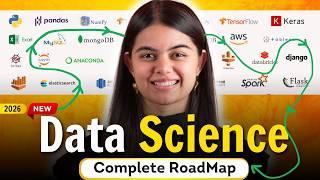
Data Science Complete RoadMap for 2026 | Apna College
1. Summary
This video from Apna College provides a comprehensive roadmap for aspiring data scientists to prepare for the year 2026. It outlines a structured learning path, starting from foundational concepts and progressing to advanced topics. The roadmap emphasizes the importance of core programming skills, mathematics, statistics, various data science libraries and tools, machine learning, deep learning, and practical application through projects and placements. The video also suggests resources for further learning and community engagement.
2. Key Takeaways
* **Structured Learning Path**: The roadmap breaks down data science into manageable stages, from basics to advanced.
* **Strong Foundation is Crucial**: Proficiency in programming (Python), mathematics (calculus, linear algebra), and statistics is essential.
* **Key Technologies**: Python, SQL, Pandas, NumPy, Matplotlib, Seaborn, Scikit-learn, TensorFlow, PyTorch are highlighted.
* **Machine Learning & Deep Learning**: These are core components of modern data science, requiring dedicated study.
* **Practical Application**: Projects, case studies, and internships are vital for hands-on experience and portfolio building.
* **Continuous Learning**: The field is dynamic, so staying updated with new trends and tools is important.
* **Placement Focus**: The roadmap is geared towards securing tech placements and internships.
* **Community Support**: Engaging with communities and mentors can accelerate learning.
3. Detailed Notes
I. Introduction & Importance of Data Science
* Data Science is a rapidly growing field with high demand for professionals.
* The roadmap is designed for students aiming for data science roles by 2026.
* Emphasis on building a strong foundation and then moving to advanced concepts.
II. Foundational Pillars
1. **Programming Language (Python)**
* **Why Python?**: Widely used in data science due to its extensive libraries, readability, and ease of use.
* **Key Concepts**:
* Basics: Variables, data types, operators, control flow (if-else, loops).
* Data Structures: Lists, tuples, dictionaries, sets.
* Functions: Defining and calling functions.
* Object-Oriented Programming (OOP): Classes, objects, inheritance.
* File Handling.
* Error Handling (Try-Except blocks).
* **Libraries**:
* **NumPy**: For numerical operations, array manipulation.
* **Pandas**: For data manipulation and analysis (DataFrames).
2. **Mathematics**
* **Linear Algebra**:
* Vectors, Matrices, Tensors.
* Matrix operations (addition, multiplication).
* Eigenvalues and Eigenvectors.
* **Importance**: Crucial for understanding algorithms like PCA, SVD, and neural network operations.
* **Calculus**:
* Derivatives and Gradients.
* Optimization techniques (Gradient Descent).
* **Importance**: Fundamental for understanding how machine learning models learn and optimize.
3. **Statistics**
* **Descriptive Statistics**: Mean, median, mode, standard deviation, variance, percentiles.
* **Inferential Statistics**: Hypothesis testing, confidence intervals, p-values.
* **Probability**: Basic probability rules, conditional probability, Bayes' theorem.
* **Distributions**: Normal distribution, binomial distribution, Poisson distribution.
* **Importance**: Essential for understanding data, drawing conclusions, and evaluating model performance.
III. Core Data Science Skills & Tools
1. **Data Manipulation & Analysis**
* **Pandas**: Deep dive into DataFrames, Series, data cleaning, merging, grouping, aggregation.
* **NumPy**: Advanced array operations, broadcasting.
2. **Data Visualization**
* **Matplotlib**: Creating static, interactive, and animated visualizations.
* **Seaborn**: Higher-level interface for statistical graphics, built on Matplotlib.
* **Types of Plots**: Histograms, scatter plots, line plots, bar plots, box plots, heatmaps.
* **Importance**: Communicating insights and understanding data patterns.
3. **Databases & SQL**
* **SQL (Structured Query Language)**:
* Basic queries: SELECT, FROM, WHERE, GROUP BY, HAVING, ORDER BY.
* Joins: INNER, LEFT, RIGHT, FULL OUTER.
* Subqueries, Window Functions.
* **Importance**: Extracting and managing data from relational databases.
IV. Machine Learning
1. **Introduction to Machine Learning**
* Types of ML: Supervised, Unsupervised, Reinforcement Learning.
* Model Training & Evaluation: Train-test split, cross-validation.
* Overfitting & Underfitting.
2. **Supervised Learning**
* **Regression**:
* Linear Regression.
* Polynomial Regression.
* Decision Trees, Random Forests.
* Gradient Boosting Machines (XGBoost, LightGBM).
* **Classification**:
* Logistic Regression.
* K-Nearest Neighbors (KNN).
* Support Vector Machines (SVM).
* Decision Trees, Random Forests.
* Naive Bayes.
* **Evaluation Metrics**: Accuracy, Precision, Recall, F1-Score, ROC AUC for classification; MSE, RMSE, MAE for regression.
3. **Unsupervised Learning**
* **Clustering**:
* K-Means Clustering.
* Hierarchical Clustering.
* DBSCAN.
* **Dimensionality Reduction**:
* Principal Component Analysis (PCA).
* t-SNE.
4. **Machine Learning Libraries**
* **Scikit-learn**: Comprehensive library for ML algorithms, preprocessing, model selection, and evaluation.
V. Deep Learning
1. **Introduction to Neural Networks**
* Perceptrons, Activation Functions.
* Multi-layer Perceptrons (MLPs).
* Backpropagation.
2. **Advanced Neural Network Architectures**
* **Convolutional Neural Networks (CNNs)**: For image recognition and computer vision tasks.
* **Recurrent Neural Networks (RNNs)**: For sequential data like text and time series (LSTM, GRU).
* **Transformers**: State-of-the-art for Natural Language Processing (NLP).
3. **Deep Learning Frameworks**
* **TensorFlow**: Powerful open-source library for numerical computation and large-scale ML.
* **Keras**: High-level API that runs on top of TensorFlow (or other backends), simplifying NN development.
* **PyTorch**: Another popular open-source ML library, known for its flexibility and ease of use in research.
VI. Advanced Topics & Specializations
* **Natural Language Processing (NLP)**: Text preprocessing, sentiment analysis, topic modeling, language generation.
* **Computer Vision**: Image classification, object detection, segmentation.
* **Time Series Analysis**: Forecasting, anomaly detection.
* **Reinforcement Learning**.
* **Big Data Technologies**: Spark, Hadoop (basic understanding).
* **Cloud Platforms**: AWS, Azure, GCP (basic familiarity with their ML services).
VII. Practical Application & Career Development
1. **Projects**:
* Build a strong portfolio of diverse projects.
* Start with simpler projects and gradually tackle more complex ones.
* Contribute to open-source projects.
2. **Case Studies**: Analyze real-world data science problems and solutions.
3. **Internships & Placements**:
* Prepare for technical interviews (DSA, ML concepts).
* Build a professional resume highlighting projects and skills.
* Networking.
4. **Continuous Learning**:
* Follow blogs, research papers, and industry news.
* Take advanced courses and certifications.
* Practice problem-solving on platforms like LeetCode, HackerRank, Kaggle.
VIII. Resources & Community
* **Apna College**:
* Course: `pri...` (link provided)
* Placement Batches: `linktr.ee/apnacollege.in`
* DSA Series: Mentioned playlist for C++ DSA.
* **Community Engagement**:
* Shradha Khapra Ma'am: Instagram (`/shradhakhapra`), LinkedIn (`/shradha-khapra`).
* Online forums, meetups, and study groups.
Related Summaries
![[캡컷PC]0015-복합클립만들기분리된영상 하나로 만들기](https://img.youtube.com/vi/qtUfil0xjCs/mqdefault.jpg)
Why this video matters
This video provides valuable insights into the topic. Our AI summary attempts to capture the core message, but for the full nuance and context, we highly recommend watching the original video from the creator.
Disclaimer: This content is an AI-generated summary of a public YouTube video. The views and opinions expressed in the original video belong to the content creator. YouTube Note is not affiliated with the video creator or YouTube.