Day-3 | Virtual Machines Part-1 | Free DevOps Course | 45 days | #devopscourse #learning #vm
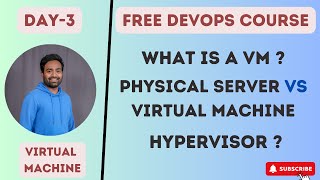
Day-3: Virtual Machines Part-1 | Free DevOps Course | Abhishek.Veeramalla
---
1. Summary
This video, Day-3 of Abhishek.Veeramalla's Free DevOps Course, introduces the crucial concept of Virtual Machines (VMs) for DevOps Engineers. It covers the fundamental definitions of servers, virtual machines, and hypervisors. The video also elaborates on the distinctions between physical and virtual machines, and highlights the significant advantages that VMs offer, making them an indispensable technology in modern IT infrastructure and DevOps practices.
---
2. Key Takeaways
* **Servers** are powerful computers that provide services or resources to other computers.
* **Virtual Machines (VMs)** are software-based emulations of physical computers, capable of running their own operating systems and applications.
* A **Hypervisor** is software that creates and manages virtual machines, allowing multiple VMs to run on a single physical machine.
* **Physical Machines (PMs)** are actual hardware devices, while **Virtual Machines (VMs)** are software abstractions of PMs.
* VMs offer numerous **advantages**, including cost-effectiveness, flexibility, scalability, improved resource utilization, and disaster recovery capabilities.
---
3. Detailed Notes
#### I. What is a Server?
* A server is a physical computer that is designed to provide services, data, or programs to other computers, known as clients.
* They are typically more powerful and reliable than client computers.
* Examples of server services: web hosting, file storage, database management, email services.
#### II. What is a Virtual Machine (VM)?
* A VM is a virtual computer that runs as a software application on a physical computer.
* It behaves like a separate, independent computer with its own operating system, applications, and resources.
* Multiple VMs can run concurrently on a single physical machine.
* Think of it as a "computer within a computer."
#### III. What is a Hypervisor?
* A hypervisor, also known as a Virtual Machine Monitor (VMM), is a layer of software that creates, runs, and manages virtual machines.
* It abstracts the physical hardware resources (CPU, memory, storage, network) and allocates them to the VMs.
* **Types of Hypervisors:**
* **Type 1 (Bare-metal):** Runs directly on the host's hardware (e.g., VMware ESXi, Microsoft Hyper-V, KVM). These are generally more performant and common in enterprise environments.
* **Type 2 (Hosted):** Runs on top of a conventional operating system as an application (e.g., Oracle VirtualBox, VMware Workstation). These are easier to set up and good for desktop use or development.
#### IV. Difference between Physical and Virtual Machine?
| Feature | Physical Machine (PM) | Virtual Machine (VM) |
| :---------------- | :-------------------------------------------------- | :---------------------------------------------------------- |
| **Nature** | Actual hardware (tangible) | Software emulation (intangible) |
| **Resource Mgmt.**| Direct access to hardware resources | Resources are virtualized and managed by the hypervisor |
| **Cost** | Higher initial hardware cost, ongoing maintenance | Lower initial cost (uses existing hardware), software licenses |
| **Deployment** | Time-consuming, requires physical setup | Fast and on-demand deployment |
| **Portability** | Difficult to move or migrate | Highly portable, can be easily moved or copied |
| **Scalability** | Requires purchasing and installing new hardware | Can be scaled up or down by adjusting virtual resources |
| **Isolation** | Naturally isolated by hardware | Isolated by the hypervisor |
| **Failure** | Hardware failure affects the entire machine | Failure of one VM generally doesn't affect others or host |
| **Resource Util.**| Can be underutilized if not fully loaded | Better resource utilization by sharing physical hardware |
#### V. Advantages of Virtual Machines
* **Cost Savings:** Reduces the need for multiple physical servers, saving on hardware, power, cooling, and space costs.
* **Resource Optimization/Utilization:** Allows better use of physical server resources by running multiple VMs on a single machine.
* **Flexibility & Agility:** Rapid deployment and provisioning of new servers. Easy to create, clone, and move VMs.
* **Scalability:** Easily scale resources (CPU, RAM, storage) up or down for individual VMs as needed.
* **Disaster Recovery & Business Continuity:** VMs can be easily backed up, replicated, and restored, improving disaster recovery capabilities.
* **Testing & Development:** Provides isolated environments for testing new software, operating systems, or configurations without impacting production systems.
* **Isolation:** VMs are isolated from each other, preventing issues in one VM from affecting others.
* **Legacy Application Support:** Can run older operating systems and applications that might not be compatible with modern hardware.
* **Simplified Management:** Centralized management of multiple servers through a single interface (hypervisor management console).
* **Snapshotting:** Ability to take a snapshot of a VM's state at a particular point in time, allowing for easy rollback if something goes wrong.
---
**Connect with Abhishek Veeramalla:**
* **Discord:** [www.youtube.com/abhishekveeramalla/join](www.youtube.com/abhishekveeramalla/join)
* **Telegram:** [https://t.me/abhishekveeramalla](https://t.me/abhishekveeramalla)
* **LinkedIn:** [https://www.linkedin.com/in/abhishek-veeramalla-77b33996/](https://www.linkedin.com/in/abhishek-veeramalla-77b33996/)
* **GitHub:** [https://github.com/iam-veeramalla](https://github.com/iam-veeramalla)
* **Medium:** [https://abhishekveeramalla-av.medium.com/](https://abhishekveeramalla-av.medium.com/)
* **YouTube Channel:** [https://www.youtube.com/channel/UCnnQ3ybuyFdzvgv2Ky5jnAA?app=desktop](https://www.youtube.com/channel/UCnnQ3ybuyFdzvgv2Ky5jnAA?app=desktop)
**Support Abhishek Veeramalla:**
* **Buy Me a Coffee:** [https://www.buymeacoffee.com/abhishekprd](https://www.buymeacoffee.com/abhishekprd)
**Udemy Course:**
* **End to End DevOps Project:** [https://www.udemy.com/course/ultimate-devops-project-with-resume-preparation/?referralCode=9F588E43854814744430](https://www.udemy.com/course/ultimate-devops-project-with-resume-preparation/?referralCode=9F588E43854814744430)
---
**Disclaimer:** Unauthorized copying, reproduction, or distribution of this video content is strictly prohibited.
Related Summaries
![[캡컷PC]0015-복합클립만들기분리된영상 하나로 만들기](https://img.youtube.com/vi/qtUfil0xjCs/mqdefault.jpg)
Why this video matters
This video provides valuable insights into the topic. Our AI summary attempts to capture the core message, but for the full nuance and context, we highly recommend watching the original video from the creator.
Disclaimer: This content is an AI-generated summary of a public YouTube video. The views and opinions expressed in the original video belong to the content creator. YouTube Note is not affiliated with the video creator or YouTube.