FINANCIAL STATEMENTS with Adjustments class 11 ONE SHOT | ACCOUNTS by GAURAV JAIN
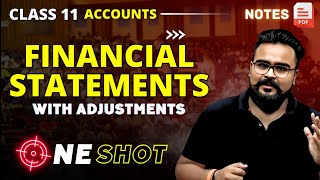
Financial Statements with Adjustments - Class 11 (One-Shot) | ACCOUNTS by GAURAV JAIN
1. Summary
This video by Gaurav Jain covers the crucial Class 11 Accounts chapter on "Financial Statements with Adjustments." The core concept revolves around understanding adjustments, why they're necessary for accurate financial reporting, and how to apply them to trading, profit & loss (P&L), and balance sheet statements. The video emphasizes the importance of the accrual basis of accounting and provides a step-by-step approach to tackle complex adjustment questions. The video then goes over 15-20 different adjustments you can see in practice. Finally, it culminates in a comprehensive example.
2. Key Takeaways
* **Accrual Basis:** Financial statements must reflect all revenues and expenses related to a specific period, regardless of actual cash flow.
* **Adjustments:** Entries made at the end of the accounting period to ensure financial statements accurately reflect the financial performance and position of a business. They are typically found below the trial balance and require double-entry accounting treatment.
* **Two-Sided Impact:** Each adjustment affects at least two accounts – typically one in the Trading/P&L and one in the Balance Sheet.
* **Understand the "Why":** Focus on the logic behind each adjustment rather than just memorizing rules.
* **Master the flow of information:** Understand what goes into each statement and where items are posted.
* **Double-Entry Bookkeeping:** Every transaction needs to be recorded in at least two places.
* **Adjustments Types:** Examples shown in video:
* Closing Stock
* Outstanding Expenses
* Prepaid Expenses
* Accrued Income
* Unearned Income
* Depreciation
* Bad Debts
* Bad Debts Recovered
* Provision for Bad Debts
* Provision for Discount on Debtors
* Manager's Commission
* Goods distributed as Samples
* Drawings (Goods)
* Goods to Staff
* Abnormal Losses (Loss by Fire etc.)
3. Detailed Notes
#### 3.1. Introduction to Adjustments (0:00:00 - 0:00:56)
* **Purpose of Adjustments:** To ensure the correct financial position of the business is reflected. This is accomplished by adhering to the accrual basis.
* **Accrual Basis Explained:** Recognizing revenue when earned and expenses when incurred, regardless of when cash changes hands.
* **What are Adjustments:** Corrections made after the Trial Balance to account for accruals (outstanding, prepaid), and other items omitted or discovered after the Trial Balance is made. Usually found below the trial balance.
* **Double Entry:** Every adjustment must have at least two entries, reflecting the double-entry bookkeeping system.
#### 3.2. Understanding the Nature of Adjustments (0:00:56-0:05:19)
* **The Double-Entry Principle:** Any item in the trial balance requires one-entry (one location), while adjustment items outside of the trial balance require two entries (two locations).
* **Trading/P&L vs. Balance Sheet:** One entry usually goes in Trading or P&L, and the other goes in the Balance Sheet.
* **Trading/P&L placement:**
* Direct Expenses (e.g., Wages, Carriage Inwards) go in the Trading Account.
* Indirect Expenses (e.g., Salaries, Depreciation, Bad Debts, Provision for Bad Debts) go in the P&L Account.
* **Important Reminder:** Every adjustment found after making the Trial Balance is treated like new information requiring at least two entries.
#### 3.3. Common Adjustments and their Treatment (0:05:19-0:08:56)
The video goes over a list of possible adjustments, and how they would generally be handled.
* **3.3.1. Closing Stock (0:05:19-0:05:41)**
* **Treatment:**
* Trading Account (Credit Side: Below Sales)
* Balance Sheet (Asset Side)
* **3.3.2. Outstanding Expenses (0:05:41-0:06:30)**
* **Treatment:**
* P&L Account or Trading Account (Add to the relevant Expense)
* Balance Sheet (Liability Side)
* **3.3.3. Prepaid Expenses (0:06:30-0:07:34)**
* **Treatment:**
* P&L or Trading Account (Subtract from the relevant expense)
* Balance Sheet (Asset Side)
* **3.3.4. Accrued Income (0:07:34-0:08:16)**
* **Treatment:**
* P&L Account (Credit Side)
* Balance Sheet (Asset Side)
* **3.3.5. Unearned Income (0:08:16-0:08:56)**
* **Treatment:**
* P&L Account (Credit Side; reduce the income)
* Balance Sheet (Liability Side)
#### 3.4. More Complex Adjustments (0:08:56-0:11:31)
* **3.4.1. Depreciation (0:08:56-0:09:47)**
* **Treatment:**
* P&L Account (Debit Side: Depreciation Expense)
* Balance Sheet (Asset Side: Reduce the asset's value by Depreciation)
* **3.4.2. Bad Debts (0:09:56-0:10:54)**
* **Treatment:**
* P&L Account (Debit Side: Bad Debts Expense)
* Balance Sheet (Deduct from Debtors)
* **3.4.3. Bad Debts Recovered (0:10:54-0:11:27)**
* **Treatment:**
* P&L Account (Credit Side)
* Add to Cash or Bank in Balance Sheet
#### 3.5. Provision for Bad Debts (0:11:31-0:13:22)
* **Definition:** An estimate of potential future losses from uncollectible debts (Debtors). Used for anticipating losses, and it is a reserve.
* **Why it's Created:** A provision is set aside to cover anticipated losses, making it a form of a reserve.
* **How it's Created:** The entry will be `P&L a/c Dr. to Provision for Bad Debts a/c`.
* **Actual Bad Debts:** The general entry is `PBD a/c Dr. to bad debts a/c`.
#### 3.6. Treatment of Provision for Bad Debts and Bad Debts (0:13:22 - 0:16:49)
* **Key Terms:**
* **Old Provision:** Provision as it appears in the Trial Balance.
* **New Provision:** Provision based on the percentage provided in the adjustments.
* **Further Bad Debts:** New bad debts reported in the adjustments section.
* **The Order of adjustments:**
* **Step 1: Further Bad Debts:** Deduct Further Bad Debts from the Debtors in the Balance Sheet.
* **Step 2: Apply Percentage:** Calculate the new Provision on the Debtors (after deducting further bad debts.)
* **Step 3: How to treat in the P&L (Profit & Loss Statement):** Compare old and new. Then, add in the P&L all items.
* **Example**
* **Debtors:** ₹ 4,00,000
* **Old Provision:** ₹ 20,000
* **Further Bad Debts:** ₹ 10,000
* **New Provision (10% on Debtors):** ₹ 38,000 (calculated as: Debtors - further bad debts = 380,000. Then, 380,000 x 10%.)
* In the P&L: (₹ 38,000 + ₹ 10,000 - ₹ 20,000) is the net bad debt expense to put on the debit side.
* On Balance Sheet: Debtors - further bad debts - new provision.
* **The Flow:**
1. Debtors (in the Balance Sheet) less Further Bad Debts = Net Debtors.
2. Calculate the Provision for Doubtful Debts on Net Debtors.
#### 3.7. Provision for Discount on Debtors (0:16:49-0:22:27)
* **Purpose:** This provision helps account for potential discounts given to debtors to encourage quicker payments.
* **Calculation:** The provision is calculated on the Debtors after deducting Further Bad Debts and the Provision for Bad Debts.
* **Treatment in Profit & Loss:** Expense will be added to bad debt expense.
* **Treatment in Balance Sheet:** The Provision for Discount on Debtors will be deducted from the Debtors.
#### 3.8. Manager's Commission (0:22:27-0:33:58)
* **Manager's Commission:**
* **Calculating the Commission:** Based on the net profit.
* **Before Charging Commission:**
* Formula: (Net Profit) x (Rate / 100)
* **After Charging Commission:**
* Formula: (Net Profit) x (Rate / (100 + Rate))
* **Placement:** P&L Account (Debit Side: Manager's Commission)
#### 3.9. Other Adjustments (0:33:58-0:36:51)
* **Interest on Capital:**
* P&L Account (Debit Side)
* Balance Sheet (Add to Capital)
* **Goods Distributed as Samples:**
* Trading Account (Purchase side, subtract from purchases)
* P&L Account (Debit Side: Advertisement Expense)
* **Personal Use (Drawings):**
* Trading Account (Purchase side, subtract from purchases)
* Balance Sheet (Deduct from Capital)
* **Goods Given to Staff:**
* Trading Account (Purchase side, subtract from purchases)
* P&L Account (Debit Side: Staff Welfare Expense)
* **Abnormal/Non-Recurring Losses:**
* Trading Account (Credit side)
* P&L Account (Debit side: Loss by fire)
#### 3.10. Implied Adjustments (0:39:45-0:41:29)
* **Implied Adjustments:** These are adjustments that are not explicitly stated but can be inferred from the information provided (e.g. a specific loan with an interest rate, but the interest has not been fully accounted for.)
#### 3.11. Comprehensive Example (0:41:29-0:55:56)
* **The Process:**
* Create Trading, P&L, and Balance Sheet (initial draft)
* Analyze adjustments one by one.
* Post each adjustment in both its Trading/P&L and Balance Sheet locations.
* Perform calculations as needed.
* Follow the structure to avoid errors.
Related Summaries
![[캡컷PC]0015-복합클립만들기분리된영상 하나로 만들기](https://img.youtube.com/vi/qtUfil0xjCs/mqdefault.jpg)
Why this video matters
This video provides valuable insights into the topic. Our AI summary attempts to capture the core message, but for the full nuance and context, we highly recommend watching the original video from the creator.
Disclaimer: This content is an AI-generated summary of a public YouTube video. The views and opinions expressed in the original video belong to the content creator. YouTube Note is not affiliated with the video creator or YouTube.