GCSE Biology Revision "Animal Cells"
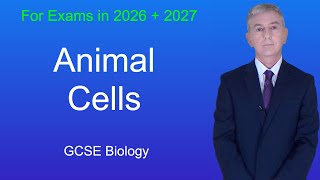
GCSE Biology Revision: Animal Cells - Freesciencelessons
---
1. Summary
This video provides a comprehensive revision of the structure and function of animal cells, specifically tailored to the AQA GCSE Biology specification. It systematically introduces the key organelles within an animal cell, explaining their individual roles and how they contribute to the cell's overall function. The video concludes with an opportunity for viewers to practice labeling an animal cell diagram, reinforcing their learning.
---
2. Key Takeaways
* Animal cells are eukaryotic cells, meaning they have a nucleus and membrane-bound organelles.
* **Nucleus:** Contains genetic material (DNA) and controls cell activities.
* **Cytoplasm:** Jelly-like substance filling the cell, where most chemical reactions occur and organelles are suspended.
* **Cell Membrane (Plasma Membrane):** Controls the movement of substances into and out of the cell.
* **Mitochondria:** Site of aerobic respiration, releasing energy for the cell. Often referred to as the "powerhouse" of the cell.
* **Ribosomes:** Responsible for protein synthesis. Can be free in the cytoplasm or attached to the endoplasmic reticulum.
* **Endoplasmic Reticulum (ER):** A network of membranes involved in protein and lipid synthesis and transport.
* **Rough ER:** Studded with ribosomes, involved in protein synthesis and modification.
* **Smooth ER:** Involved in lipid synthesis, detoxification, and calcium storage.
* **Golgi Apparatus (Golgi Body/Golgi Complex):** Modifies, sorts, and packages proteins and lipids for secretion or delivery to other organelles.
* **Lysosomes:** Contain digestive enzymes to break down waste materials and cellular debris. (Note: While common in animal cells, their presence and prominence can vary, and some curricula might emphasize them less than other organelles).
* **Vacuoles:** In animal cells, vacuoles are typically small and temporary, involved in storage or transport. (Contrast with the large central vacuole in plant cells).
* The video includes a labeling exercise for an animal cell diagram.
---
3. Detailed Notes
#### Introduction
* Video focuses on animal cells, relevant to AQA GCSE Biology spec.
* May also be suitable for iGCSE/O Level Biology.
* Emphasizes understanding the function of each part.
#### Key Structures and Their Functions
1. **Nucleus**
* **Description:** A large, spherical or oval organelle.
* **Function:**
* Contains the genetic material (DNA) in the form of chromosomes.
* Controls all cell activities, including growth, metabolism, and reproduction.
* The "control center" of the cell.
2. **Cytoplasm**
* **Description:** A jelly-like substance that fills the cell, enclosed by the cell membrane.
* **Function:**
* Suspends the organelles within the cell.
* The site where most chemical reactions (metabolism) take place.
3. **Cell Membrane (Plasma Membrane)**
* **Description:** A thin, flexible outer boundary of the cell.
* **Function:**
* Regulates the passage of substances (nutrients, waste products) into and out of the cell.
* Selectively permeable.
4. **Mitochondria**
* **Description:** Oval-shaped organelles with a folded inner membrane.
* **Function:**
* Site of **aerobic respiration**.
* Releases energy from glucose in the presence of oxygen.
* This energy is used to power all cellular activities.
* Often called the "powerhouse" of the cell.
5. **Ribosomes**
* **Description:** Tiny organelles, often appearing as small dots.
* **Function:**
* Responsible for **protein synthesis** (making proteins).
* Found free in the cytoplasm or attached to the Rough Endoplasmic Reticulum.
6. **Endoplasmic Reticulum (ER)**
* **Description:** A network of interconnected membranes forming sacs and tubules throughout the cytoplasm.
* **Types:**
* **Rough ER (RER):**
* Has ribosomes attached to its surface.
* Involved in the synthesis and modification of proteins, especially those destined for export or insertion into membranes.
* **Smooth ER (SER):**
* Lacks ribosomes.
* Involved in lipid synthesis, detoxification of drugs and poisons, and storage of calcium ions.
7. **Golgi Apparatus (Golgi Body / Golgi Complex)**
* **Description:** A stack of flattened membrane-bound sacs called cisternae.
* **Function:**
* Receives proteins and lipids from the ER.
* Modifies, sorts, and packages these molecules into vesicles.
* Involved in secretion (releasing substances from the cell) and transport of materials to other organelles.
8. **Lysosomes**
* **Description:** Small, membrane-bound sacs containing hydrolytic (digestive) enzymes.
* **Function:**
* Break down waste materials, cellular debris, and foreign invaders (like bacteria).
* Aid in intracellular digestion.
9. **Vacuoles**
* **Description:** Membrane-bound sacs.
* **Function in Animal Cells:**
* Generally small and temporary.
* Can store water, ions, nutrients, or waste products.
* Can be involved in transport.
* (Note: Contrast with the large, permanent central vacuole in plant cells).
#### Cell Labeling Exercise
* The video provides an unlabeled diagram of an animal cell.
* Viewers are encouraged to pause the video and label the organelles based on the information presented.
* The labeled diagram is then revealed for self-checking.
#### Conclusion
* Recap of the importance of understanding animal cell structure for GCSE Biology.
* Encouragement to use the provided resources (website, workbooks) for further study.
---
Related Summaries
![[캡컷PC]0015-복합클립만들기분리된영상 하나로 만들기](https://img.youtube.com/vi/qtUfil0xjCs/mqdefault.jpg)
Why this video matters
This video provides valuable insights into the topic. Our AI summary attempts to capture the core message, but for the full nuance and context, we highly recommend watching the original video from the creator.
Disclaimer: This content is an AI-generated summary of a public YouTube video. The views and opinions expressed in the original video belong to the content creator. YouTube Note is not affiliated with the video creator or YouTube.