How To Ask Right Questions In Sales by Sales Expert Coach Animesh
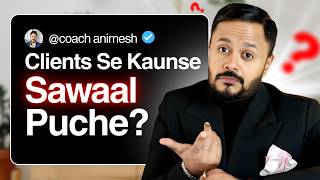
How To Ask Right Questions In Sales - Notes by Coach Animesh
1. Summary
This video by Coach Animesh emphasizes the crucial role of asking the right questions in sales to improve conversions, build trust, and close deals naturally. The core message is that sales success hinges on being a consultant who understands the client's needs by asking targeted questions, rather than simply presenting a product or service. The video outlines a 4-type sales questioning framework used by top closers.
2. Key Takeaways
* **Asking the right questions is more important than product quality.** Many salespeople lose deals because they don't ask effective questions.
* **The 4-type sales questioning framework:** Profiling, Pain Point, Implication, and Vision questions.
* **Benefits of using the framework:** Increased conversions, easy handling of objections, and deeper understanding of the client.
* **Avoid asking direct, upfront questions about budget or immediate purchase intent.** These can create a negative impression.
* **Focus on being a consultant, not just a salesperson, by asking questions and understanding client needs.**
3. Detailed Notes
**I. Introduction & Problem Statement (0:00:00 - 0:00:10)**
* Most salespeople don't ask enough questions, and this is why they fail.
* Sales is about asking questions, not just selling.
* Salespeople need to act as consultants, like doctors or lawyers, who ask questions to understand their client's needs.
**II. The Power of Asking Questions (0:00:10 - 0:00:54)**
* Asking questions helps clients see you as an advisor, building trust.
* Focus on the right set of questions to improve sales.
**III. The 4-Type Sales Questioning Framework (0:01:46 - 0:08:41)**
**A. Profiling Based Questions (0:01:46 - 0:02:59)**
* Also known as "prospecting-based questions."
* Focus: Understanding the client's situation and needs.
* Examples:
* "Are you looking for this product/service for yourself or someone else?"
* "Are you looking for this for daily use, or for a specific occasion?"
* (In real estate) "Where do you live? How many people are in your family?"
* Benefits: Gather information, show you care, and build rapport.
* Action: Create 5 profiling questions specific to your industry.
**B. Pain Point Questions (0:04:08 - 0:05:39)**
* Also called "problem questions."
* Focus: Uncovering and amplifying the client's pain points to make them realize the severity of the problem.
* Examples:
* "What is the biggest challenge you are facing right now?"
* "How is this problem delaying your work?"
* "How is your stress level increasing?"
* "What loss could you face if this problem continues?"
* (Coaching Example): "What if this low performance continues?"
* Benefits: Helps the client see the need for a solution and increases urgency.
* The client is more likely to make a decision if they articulate the problem.
**C. Implication Questions (0:05:41 - 0:07:38)**
* Focus: Building urgency by highlighting the consequences of delaying a decision.
* Helps overcome the tendency to delay decisions.
* Examples:
* "If this problem continues for 6 months, how will it affect your revenue?"
* "How much longer do you want to be stressed?"
* (Hair Transplant Example): If you delay this, you might have fewer grafts left, resulting in greater cost.
* Benefits: Creates a sense of urgency without being pushy or making the client feel pressure.
* FOMO (Fear of Missing Out) can be used: "Are you missing an opportunity?"
**D. Vision Questions (0:07:38 - 0:08:38)**
* Focus: Painting a picture of the future after the client implements your solution.
* Examples:
* "If this problem is solved in a year, how will your business look?"
* "How soon are you looking to transform your team?"
* "What’s your ideal future outcome?"
* (Real Estate Example): "If you invested 5 years ago, you could have tripled your money. I don't want you to regret this 5 years from now."
* Benefits: Motivates the client by showing the positive impact and encourages decision-making.
**IV. Bonus: Questions to Avoid (0:08:41 - 0:09:37)**
* **Weak and Direct Questions**: E.g., "What's your budget?" "Are you interested?" "Are you ready?"
* Creates a negative atmosphere.
* **Authority-Killing Questions**: E.g., "What do you think?" "I'm waiting for you." "Will there be a discount?"
* Undermines your authority.
* **Desperate Questions**: E.g., "Please buy." "Please come for a demo." "Please come for a visit."
* Creates a feeling of desperation and lowers your authority.
**V. Golden Rule of Sales Questioning (0:09:37 - 0:09:55)**
* Questions are for guiding the client to a decision.
* Good questions position you as a consultant leading to a natural close.
**VI. Conclusion (0:09:55 - 0:10:44)**
* Encouragement to like, comment and subscribe for more sales and business content.
* Recommendations for courses, including Sales Master Transformation and Sales Dominator Kit.
Related Summaries
![[캡컷PC]0015-복합클립만들기분리된영상 하나로 만들기](https://img.youtube.com/vi/qtUfil0xjCs/mqdefault.jpg)
Why this video matters
This video provides valuable insights into the topic. Our AI summary attempts to capture the core message, but for the full nuance and context, we highly recommend watching the original video from the creator.
Disclaimer: This content is an AI-generated summary of a public YouTube video. The views and opinions expressed in the original video belong to the content creator. YouTube Note is not affiliated with the video creator or YouTube.