HUMAN REPRODUCTION in ONE SHOT | All Concepts & PYQs | Basics to Advanced | Class 12 NEET
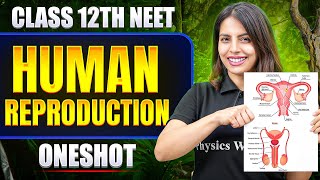
Human Reproduction - Comprehensive Notes (Class 12 NEET)
**Source:** HUMAN REPRODUCTION in ONE SHOT | All Concepts & PYQs | Basics to Advanced | Class 12 NEET
**Channel:** PW NEET
---
1. Summary
This video provides a comprehensive one-shot explanation of Human Reproduction, covering all essential concepts for Class 12 NEET preparation, from basic to advanced levels. It aims to equip students with a thorough understanding of the male and female reproductive systems, gametogenesis, fertilization, implantation, embryonic development, parturition, and lactation. The session also incorporates Previous Year Questions (PYQs) to solidify learning and exam readiness.
---
2. Key Takeaways
* **Two Stages of Reproduction:** Asexual (not in humans) and Sexual reproduction.
* **Sexual Reproduction in Humans:** Involves formation of male and female gametes, fusion of gametes (fertilization), formation of zygote, and development of zygote into an embryo and then into an organism.
* **Male Reproductive System:** Primarily comprises testes, accessory ducts, glands, and external genitalia.
* **Female Reproductive System:** Consists of ovaries, oviducts, uterus, cervix, vagina, and external genitalia.
* **Gametogenesis:** Process of gamete formation - Spermatogenesis (in males) and Oogenesis (in females).
* **Menstrual Cycle:** A recurring monthly cycle in females involving changes in the ovaries and uterus, crucial for ovulation and preparation for pregnancy.
* **Fertilization:** Fusion of sperm and ovum to form a zygote, typically occurring in the ampulla of the fallopian tube.
* **Embryonic Development:** Includes cleavage, morula, blastocyst formation, implantation, and gastrulation leading to the formation of germ layers.
* **Placentation:** Formation of the placenta, an organ that facilitates nutrient and waste exchange between mother and fetus.
* **Gestation Period:** The period of embryonic development within the uterus, lasting approximately 9 months.
* **Parturition:** The process of childbirth.
* **Lactation:** The production and secretion of milk by mammary glands after childbirth.
* **Hormonal Regulation:** Key hormones like GnRH, FSH, LH, testosterone, estrogen, progesterone, hCG, hPL, relaxin play vital roles throughout reproduction.
* **Assisted Reproductive Technologies (ART):** Techniques like IVF, GIFT, ZIFT, ICSI are discussed for overcoming infertility.
---
3. Detailed Notes
#### I. Introduction to Reproduction
* **Definition:** Biological process by which new individual organisms – offspring – are produced from their parents.
* **Types of Reproduction:**
* **Asexual Reproduction:** Offspring are formed from a single parent and inherit the genes of that parent only. (Not applicable to humans).
* **Sexual Reproduction:** Involves the fusion of male and female gametes to form a zygote. Inherits genetic material from both parents.
* **Key Events in Sexual Reproduction (Humans):**
1. **Gametogenesis:** Formation of gametes (sperm and ovum).
2. **Insemination:** Transfer of sperm into the female reproductive tract.
3. **Fertilization:** Fusion of male and female gametes.
4. **Implantation:** Attachment of the blastocyst to the uterine wall.
5. **Gestation:** Embryonic development.
6. **Parturition:** Childbirth.
#### II. Male Reproductive System
* **Primary Sex Organs:** Testes (paired)
* **Location:** Located within the scrotum (external to the abdominal cavity).
* **Function of Scrotum:** Maintains the testes' temperature at about 2-2.5°C lower than the normal body temperature, which is optimal for spermatogenesis.
* **Structure of Testis:** Oval-shaped, about 4-5 cm in length. Composed of seminiferous tubules.
* **Seminiferous Tubules:** Site of sperm production (spermatogenesis).
* **Sertoli Cells:** Nourish the developing sperms.
* **Leydig Cells (Interstitial Cells):** Located in the interstitial spaces outside seminiferous tubules, produce androgens (like testosterone).
* **Accessory Ducts:**
* **Vasa Efferentia:** Carry sperm from seminiferous tubules to epididymis.
* **Epididymis:** Coiled tube where sperm mature and are stored.
* **Vas Deferens (Ductus Deferens):** Carries sperm from epididymis to ejaculatory duct.
* **Ejaculatory Duct:** Formed by the union of vas deferens and duct of seminal vesicle; passes through the prostate and empties into the urethra.
* **Urethra:** Extends from the urinary bladder to the outside, carries both urine and semen.
* **Accessory Glands:**
* **Seminal Vesicles (Paired):** Secrete a yellowish, alkaline fluid rich in fructose, prostaglandins, and clotting factors. Fructose provides energy to sperm.
* **Prostate Gland (Single):** Secretes a milky, slightly acidic fluid containing citric acid, enzymes (like prostatic-specific antigen - PSA), and zinc. Helps activate sperm.
* **Bulbourethral Glands (Cowper's Glands) (Paired):** Secrete a viscous, clear secretion that lubricates the urethra and neutralizes any acidic urine residue.
* **External Genitalia:**
* **Penis:** External male reproductive organ.
* **Structure:** Composed of erectile tissue (corpora cavernosa and corpus spongiosum).
* **Function:** Facilitates insemination. The enlarged tip is called the glans penis, covered by a loose fold of skin called the prepuce.
#### III. Spermatogenesis
* **Definition:** The process of formation of motile male gametes (sperms) from spermatogonia.
* **Location:** Seminiferous tubules of the testes.
* **Hormonal Regulation:** Initiated by GnRH from the hypothalamus; stimulates anterior pituitary to release LH and FSH.
* **LH:** Stimulates Leydig cells to produce androgens (testosterone).
* **FSH:** Acts on Sertoli cells to stimulate sperm production.
* **Androgens:** Support spermatogenesis.
* **Stages:**
1. **Spermatocytogenesis:**
* **Spermatogonium (2n):** Diploid germ cells that undergo mitotic divisions.
* **Primary Spermatocyte (2n):** Differentiates from spermatogonium and undergoes meiosis I.
2. **Meiosis:**
* **Secondary Spermatocyte (n):** Haploid cells formed after meiosis I of primary spermatocyte. Undergo meiosis II.
* **Spermatid (n):** Haploid cells formed after meiosis II of secondary spermatocyte.
3. **Spermiogenesis (Metamorphosis):** Transformation of spermatid into a spermatozoon (sperm).
* **Sperm Structure:** Head (contains nucleus with haploid chromosomes and acrosome), Neck, Middle Piece (contains mitochondria), Tail (for motility).
* **Seminal Plasma:** Produced by accessory glands, it is alkaline and aids in sperm transport and motility.
#### IV. Female Reproductive System
* **Primary Sex Organs:** Ovaries (paired)
* **Location:** Pelvic region of the abdomen.
* **Structure:** Almond-shaped, 2-4 cm in length.
* **Function:** Produce ova (eggs) and female sex hormones (estrogen and progesterone).
* **Accessory Ducts:**
* **Oviducts (Fallopian Tubes) (Paired):** 10-12 cm long, extend from the periphery of the ovary to the uterus.
* **Infundibulum:** Funnel-shaped part near the ovary, with finger-like projections called fimbriae, which help capture the ovulated egg.
* **Ampulla:** Wider, straight part. Fertilization usually occurs here.
* **Isthmus:** Narrow, short terminal part connected to the uterus.
* **Uterus (Womb):** A large, inverted pear-shaped muscular organ.
* **Location:** Supported by ligaments in the pelvic cavity.
* **Structure:**
* **Fundus:** Upper dome-shaped part.
* **Body:** Main central part.
* **Cervix:** Lower, narrow part that opens into the vagina.
* **Uterine Wall Layers:**
* **Perimetrium:** Outermost thin membrane.
* **Myometrium:** Thick middle layer of smooth muscles, contracts during childbirth.
* **Endometrium:** Innermost glandular layer, undergoes cyclic changes during the menstrual cycle and is the site of implantation.
* **Cervix:** Connects uterus to vagina. Cervical canal is the passage through the cervix.
* **Vagina:** Muscular tube, 7-10 cm long, extending from the cervix to the outside. Receives sperms during copulation and also serves as the birth canal.
* **External Genitalia (Vulva):**
* **Mons Pubis:** Fatty tissue covered by skin and pubic hair.
* **Labia Majora:** Fleshy folds of skin, homologous to scrotum.
* **Labia Minora:** Smaller folds of skin within the labia majora.
* **Clitoris:** Small, finger-like structure located at the anterior junction of the labia minora, highly sensitive. Homologous to penis.
* **Hymen:** A thin membrane that may partially cover the vaginal opening.
* **Bartholin's Glands:** Secrete lubricating fluid.
#### V. Oogenesis
* **Definition:** The process of formation of female gametes (ova) from oocytes.
* **Location:** Ovaries.
* **Stages:**
1. **Oogonial Proliferation:** Oogonia (2n) are formed during the embryonic stage. They multiply by mitosis.
2. **Primary Oocyte Formation:** Oogonia enter meiosis I and get arrested at Prophase I, forming primary oocytes (2n). Each primary oocyte is surrounded by a layer of granulosa cells, forming a **primary follicle**.
3. **Follicular Development:**
* **Primary Follicles:** Develop into **Secondary Follicles**.
* **Secondary Follicles:** Develop into **Tertiary Follicles**.
* **Tertiary Follicle:** Characterized by a fluid-filled cavity called the **antrum**. The primary oocyte inside completes Meiosis I, forming a large **secondary oocyte (n)** and a small **first polar body (n)**. The secondary oocyte is arrested at Metaphase II.
* **Graafian Follicle:** Mature tertiary follicle.
4. **Ovulation:** The Graafian follicle ruptures, and the secondary oocyte (arrested at Metaphase II) is released from the ovary.
5. **Completion of Meiosis II:** If fertilization occurs, the secondary oocyte completes Meiosis II, forming a mature ovum (n) and a **second polar body (n)**. If fertilization does not occur, the secondary oocyte degenerates.
* **Ovarian Follicle Structure:** Granulosa cells, theca interna, theca externa.
#### VI. Menstrual Cycle
* **Definition:** Cyclic changes in the uterine endometrium and ovaries in sexually mature females, occurring approximately every 28 days.
* **Hormonal Control:** Regulated by interplay of pituitary hormones (LH, FSH) and ovarian hormones (estrogen, progesterone).
* **Phases:**
1. **Menstrual Phase (Days 1-5):**
* Shedding of the uterine endometrium, leading to bleeding.
* Caused by a drop in progesterone and estrogen levels.
* Starts with the first day of menstruation.
2. **Follicular Phase (Proliferative Phase) (Days 6-13):**
* Regeneration of the endometrium.
* FSH stimulates follicular development in the ovary.
* Developing follicles produce estrogen, which stimulates endometrial proliferation.
* Ovulation occurs around day 14.
3. **Ovulatory Phase (Day 14):**
* Surge in LH triggers ovulation.
4. **Luteal Phase (Secretory Phase) (Days 15-28):**
* Remnant of Graafian follicle forms the **Corpus Luteum**.
* Corpus Luteum secretes progesterone and some estrogen.
* Progesterone prepares the endometrium for implantation (makes it receptive).
* If fertilization occurs, corpus luteum persists, maintained by hCG.
* If fertilization does not occur, corpus luteum degenerates after about 10 days, leading to a drop in progesterone and estrogen, initiating the next menstrual cycle.
#### VII. Fertilization
* **Definition:** Fusion of sperm and ovum to form a diploid zygote.
* **Location:** Ampulla of the fallopian tube.
* **Process:**
1. **Insemination:** Sperms are deposited in the vagina.
2. **Capacitation:** Changes in the sperm within the female reproductive tract that enable them to fertilize the ovum.
3. **Passage through cervix, uterus, and oviduct:** Sperms travel towards the ovum.
4. **Acrosomal Reaction:** Sperm penetrates the corona radiata and zona pellucida of the ovum, releasing enzymes (hyaluronidase, acrosin).
5. **Fusion:** Sperm head fuses with the ovum.
6. **Cortical Reaction & Zona Reaction:** Prevent polyspermy (fertilization by more than one sperm).
7. **Completion of Meiosis II:** Secondary oocyte completes meiosis to form ovum and second polar body.
8. **Formation of Zygote:** Nuclei of sperm and ovum fuse to form a diploid zygote.
#### VIII. Embryonic Development
* **Cleavage:** Rapid mitotic divisions of the zygote as it travels down the oviduct.
* **2-celled stage → 4-celled stage → 8-celled stage → 16-celled stage.**
* **Morula:** A solid ball of 16-32 blastomeres. Reaches the uterus around 3-4 days after fertilization.
* **Blastocyst:** Morula develops a fluid-filled cavity called the **blastocoel**.
* **Trophoblast:** Outer layer of cells, responsible for implantation and forming extra-embryonic membranes.
* **Inner Cell Mass (ICM):** Cluster of cells inside the blastocyst, differentiates into the embryo.
* **Implantation:** Attachment of the blastocyst to the uterine endometrium. Occurs about 6-7 days after fertilization. Trophoblast cells divide and differentiate.
* **Gastrulation:** The process by which the inner cell mass differentiates into three primary germ layers:
* **Ectoderm:** Forms nervous system, epidermis of skin, sense organs.
* **Mesoderm:** Forms muscles, skeleton, circulatory system, excretory and reproductive systems.
* **Endoderm:** Forms lining of digestive tract, respiratory tract, liver, pancreas.
* **Formation of Extra-embryonic Membranes:**
* **Amnion:** Encloses the amniotic fluid, which protects the embryo.
* **Chorion:** Forms the fetal part of the placenta.
* **Allantois:** Forms part of the umbilical cord and contributes to the placenta.
* **Yolk Sac:** In humans, its role is minimal; it is involved in early blood cell formation.
#### IX. Placentation
* **Placenta:** A specialized organ connecting the developing fetus to the uterine wall, providing nourishment and waste removal.
* **Formation:** Formed by the chorionic villi (from chorion) and uterine tissue.
* **Functions:**
* Nutrient supply (glucose, amino acids, fats, vitamins, minerals).
* Oxygen supply.
* Waste removal (CO2, urea).
* Hormone production (progesterone, estrogen, hCG, hPL, relaxin).
* Antibody transfer (passive immunity).
* **Umbilical Cord:** Connects the placenta to the fetus. Contains umbilical arteries and veins.
#### X. Gestation and Parturition
* **Gestation Period:** The period of embryonic and fetal development within the uterus. In humans, it is approximately 9 months (about 280 days from last menstrual period).
* **Fetal Development:** Organs develop, limbs and digits form, etc.
* **Parturition (Childbirth):** The process of expulsion of the fetus from the uterus.
* **Trigger:** Complex process involving hormonal signals (oxytocin, prostaglandins) and mechanical stretching of the uterus.
* **Stages:**
1. **Dilation Stage:** Cervix dilates, amniotic sac ruptures.
2. **Expulsion Stage:** Fetus is pushed out of the uterus through the birth canal.
3. **Placental Stage:** Expulsion of the placenta.
* **Hormonal Role:** Oxytocin stimulates uterine contractions. Relaxin relaxes pelvic ligaments.
#### XI. Lactation
* **Definition:** Production and secretion of milk by the mammary glands after childbirth.
* **Mammary Glands:** Modified sweat glands.
* **Hormonal Control:**
* **Prolactin:** Stimulates milk production.
* **Oxytocin:** Stimulates milk ejection reflex (let-down reflex).
* **Colostrum:** The first milk secreted by mammary glands, rich in antibodies, minerals, and vitamins, crucial for infant immunity.
* **Significance:** Provides nourishment and antibodies to the newborn.
#### XII. Assisted Reproductive Technologies (ART)
* **In Vitro Fertilization (IVF):** Fertilization of eggs by sperm outside the body ("in glass"). Embryo is then transferred to the uterus.
* **Gamete Intrafallopian Transfer (GIFT):** Transfer of ovum and sperm into the fallopian tube.
* **Zygote Intrafallopian Transfer (ZIFT):** Transfer of zygote into the fallopian tube.
* **Intracytoplasmic Sperm Injection (ICSI):** Direct injection of a single sperm into an ovum.
* **Intrauterine Insemination (IUI):** Introduction of semen directly into the uterus.
#### XIII. Previous Year Questions (PYQs) - General Themes (Refer to video for specific questions)
* **Structure and Function:** Male and female reproductive organs, gametes, accessory glands.
* **Hormonal Regulation:** Role of FSH, LH, estrogen, progesterone, testosterone, hCG in menstrual cycle, pregnancy, and parturition.
* **Gametogenesis:** Spermatogenesis and Oogenesis steps, ploidy levels.
* **Fertilization and Implantation:** Location, process, prevention of polyspermy.
* **Embryonic Development:** Stages like cleavage, morula, blastocyst, gastrulation, germ layer derivatives.
* **Placenta:** Functions and hormone production.
* **Menstrual Cycle:** Phases and hormonal changes.
* **ART:** Definitions and applications.
---
Related Summaries
![[캡컷PC]0015-복합클립만들기분리된영상 하나로 만들기](https://img.youtube.com/vi/qtUfil0xjCs/mqdefault.jpg)

Why this video matters
This video provides valuable insights into the topic. Our AI summary attempts to capture the core message, but for the full nuance and context, we highly recommend watching the original video from the creator.
Disclaimer: This content is an AI-generated summary of a public YouTube video. The views and opinions expressed in the original video belong to the content creator. YouTube Note is not affiliated with the video creator or YouTube.