Introduction to General Physiology
Introduction to General Physiology - Notes
**Video Summary:** This video serves as an introduction to the field of general physiology. It emphasizes the organization of the human body, from cells to organ systems, and highlights the importance of maintaining a stable internal environment (homeostasis) for proper cellular function and overall health. The video covers the concept of homeostasis, body fluid distribution, the origin of nutrients, the removal of waste, and the roles of the nervous and endocrine systems in regulating bodily functions. Furthermore, it explains the mechanisms of negative and positive feedback loops.
**Key Takeaways:**
* The body is a complex system of approximately 100 trillion cells organized into functional structures (organs) that work in harmony.
* Homeostasis, the maintenance of a stable internal environment, is crucial for cell survival and function.
* The extracellular fluid (internal environment) provides the necessary nutrients and removes waste for cells.
* The nervous and endocrine systems are major regulators of bodily functions.
* Negative feedback mechanisms maintain stability, while positive feedback amplifies a response.
**Detailed Notes:**
**I. Introduction to Physiology**
* **Definition:** Physiology is the science that explains the physical and chemical mechanisms responsible for the origin, development, and progression of life.
* **Focus:** Study of function in the living organism.
* **Human Body's Organization:**
* Atoms -> Molecules -> Macromolecules -> Organelles -> Cells -> Tissues -> Organs -> Organ Systems -> Organism (Human being).
* Cells: The basic functional units of the body; approximately 100 trillion cells in the body.
* Example: Red blood cells (approximately 25 trillion cells)
* **Functional Characteristics of the Human Body**:
* All cells perform basic functions:
* Acquiring oxygen and nutrients.
* Delivering the end products of the chemical reactions to the surrounding fluid (extracellular fluid).
* Reproducing.
* **Sensing & Feeling:** The automatic sequence of life allows us to sense, feel, and be eligible beings.
**II. Body Fluid Distribution**
* **Total Body Fluid:** Approximately 60% of the adult human body is fluid.
* **Intracellular Fluid (ICF):** Fluid inside the cells (approximately 2/3 of the total body fluid).
* **Extracellular Fluid (ECF):** Fluid outside the cells (approximately 1/3 of the total body fluid).
* Constant motion throughout the body.
* Rapidly transported in circulating blood.
* Mixed between the blood and tissue fluids by diffusion through capillary walls.
**III. Extracellular Fluid (ECF) - The Internal Environment**
* **Definition:** The internal environment of the body.
* **Function:** Provides the ions and nutrients needed by cells to maintain life.
* **Composition:** Contains ions, nutrients (oxygen, glucose, fatty acids, amino acids), and waste products.
* **Components of an Average Young Adult's Body:**
* Proteins (80%).
* Minerals (77%).
* Fats and other lipids (15%).
* **Intracellular fluid Composition:**
* Contains large amounts of potassium, magnesium, and phosphate ions.
**IV. Homeostasis**
* **Definition:** The maintenance of nearly constant conditions in the internal environment.
* **Relatable Definition:** Any self-regulating process by which biological systems tend to maintain stability or balance.
* **Organ System Contribution:** All organs and tissues perform functions that help maintain relative constant conditions.
* Example:
* Lungs: Provide oxygen to the ECF.
* Kidneys: Maintain constant ion concentrations.
* Gastrointestinal system: Provides nutrients.
**V. Origin of Nutrients in ECF**
* **Systems Involved:**
* Respiratory system: Delivers oxygen.
* Gastrointestinal tract: Absorbs dissolved nutrients.
* Liver and other organs of metabolism: Change the chemical composition of many absorbed substances to usable forms.
* Musculoskeletal system: Aids the body in obtaining food and provides mobility.
**VI. Removal of Metabolic End Products**
* **Systems Involved:**
* Lungs: Removal of carbon dioxide.
* Kidneys: Excretion of metabolic waste products.
* Gastrointestinal Tract: Elimination of undigested materials and waste products.
* Liver: Detoxification of drugs and chemicals.
**VII. Regulation of Body Functions**
* **Systems Involved:**
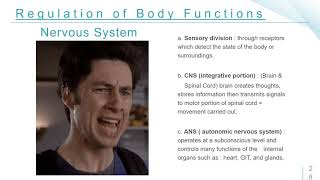
* **Nervous System:** (Sweating, fight or flight responses, digest)
* Sensory input, central nervous system (integrative), motor output.
* Autonomic system (subconscious level) – controls internal organs.
* **Endocrine System:** (Love hormones)
* Hormones: Chemical substances secreted by endocrine glands and organs, transported in the ECF, to regulate cellular function.
**VIII. Control Systems**
* **Examples:**
* Regulation of oxygen and carbon dioxide concentrations.
* Regulation of arterial blood pressure.
* **Regulation of Oxygen and Carbon Dioxide:**
* Increased CO2 levels during exercise triggers increased breathing (respiratory center) which leads to eliminate carbon dioxide from blood.
* **Regulation of Arterial Pressure:**
* Baroreceptors in the arterial walls detect changes in pressure.
* Increased arterial pressure stretches the walls and inhibits the vasomotor center (medulla and pons), which leads to decrease impulses to the heart and blood vessels.
* Blood flow decreases.
* Fall in arterial pressure: The stretch receptors are relaxed, causing vasocenters to become more active.
* **Characteristics of Control Systems:**
* **Negative Feedback:**
* A variable triggers a counteracting response to return to a set point. (e.g., body temperature regulation)
* Example: high blood sugar → insulin released → cells take up glucose → blood sugar lowers
* **Positive Feedback:**
* A variable triggers a response that intensifies the variable.
* Example: childbirth (contractions increase hormone release and pressure).
* **Type 1 Diabetes:** A disorder where negative feedback might not work due to inability of the body to produce insulin.
* **Adaptive control/Delayed Negative Feedback:**
* Feed-forward control for rapid movements.
* Sensory nerve signals from the moving parts apprise the brain whether the movement is performed correctly or not.
* The brain corrects feed-forward signals to the muscles for subsequent movements.
* Example: catching a falling object.
Related Summaries
![[캡컷PC]0015-복합클립만들기분리된영상 하나로 만들기](https://img.youtube.com/vi/qtUfil0xjCs/mqdefault.jpg)

Why this video matters
This video provides valuable insights into the topic. Our AI summary attempts to capture the core message, but for the full nuance and context, we highly recommend watching the original video from the creator.
Disclaimer: This content is an AI-generated summary of a public YouTube video. The views and opinions expressed in the original video belong to the content creator. YouTube Note is not affiliated with the video creator or YouTube.