Laws of Motion 🔥 | CLASS 11 Physics | Complete Chapter | NCERT Covered | Prashant Kirad
Laws of Motion 🔥 | CLASS 11 Physics | Complete Chapter | NCERT Covered | Prashant Kirad - Summary and Notes
**Summary:**
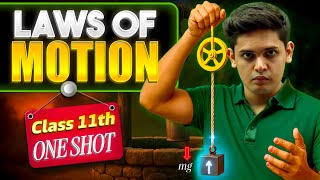
This video by Prashant Kirad provides a comprehensive one-shot lecture on the Laws of Motion for Class 11 Physics, covering key concepts from the NCERT syllabus. It starts with an introduction to forces, moves on to Newton's Laws of Motion, discusses momentum, and explores concepts like tension, friction, and dynamics of circular motion. The lecture emphasizes conceptual understanding, problem-solving techniques, and real-life examples.
**Key Takeaways:**
* **Force as a Push or Pull:** The fundamental concept of force is introduced.
* **Newton's Laws of Motion:** Detailed explanations of all three laws and their applications.
* **Inertia and Momentum:** Important concepts to understand Newton's First and Second Laws.
* **Types of Forces:** Contact (friction, normal, tension) and non-contact forces (gravitational, electrostatic, magnetic).
* **Sudo forces:** Explained in non-inertial frames.
* **Friction and Circular Motion:** Explores the different types and properties of friction and the dynamics involved.
* **Emphasis on Problem Solving:** The video includes numerous examples and problem-solving strategies.
* **Application of Concepts:** Examples related to everyday life, such as catching a ball and car dynamics.
**Detailed Notes:**
1. **Introduction (0:00 - 1:13)**
* Introduction to the chapter and the importance of understanding the concepts.
* The chapter covers Newton's Laws of Motion.
* Motivation to study with the PK bhaiya.
2. **Force (1:13 - 10:15)**
* Force defined as a push or a pull.
* Force is a vector quantity.
* Basic formula: *F = ma*.
* SI unit of force: Newton (N).
* Dimensional formula: \[MLT⁻²]
* Effects of force:
* Changes speed.
* Changes direction.
* Changes shape and size.
* Types of Forces in Mechanics
* Contact forces
* Friction
* Normal force
* Tension
* Spring Force
* Non-contact forces
* Gravitational force
* Electrostatic force
* Magnetic force
* Types of Forces:
* Balanced: Net force is zero.
* Unbalanced: Net force is not zero.
* Aristotle's view on motion was that continuous external force is needed to keep an object in motion (Wrong).
3. **Newton's First Law of Motion (10:15 - 14:37)**
* **Inertia**: The natural tendency of an object to resist any change in its state of motion or rest.
* Inertia is directly proportional to mass.
* Types of Inertia:
* Inertia of Rest: Tendency to remain at rest.
* Example: A person in a car jerks backward when the car starts.
* Inertia of Motion: Tendency to remain in motion.
* Example: When a car stops suddenly, the person goes forward.
* Inertia of Direction: Tendency to move in the same direction.
* Newton's First Law (Law of Inertia): An object at rest stays at rest, and an object in motion stays in motion with the same speed and in the same direction unless acted upon by an external unbalanced force.
4. **Newton's Second Law of Motion (14:37 - 41:27)**
* **Momentum:** The product of mass and velocity (*p = mv*).
* Momentum is a vector quantity.
* Unit: kg m/s.
* Dimensional formula: \[MLT⁻¹].
* Newton's Second Law: The rate of change of momentum of an object is directly proportional to the net force applied, and the change in momentum occurs in the direction of the net force.
* *F = Δp/Δt*.
* *F = ma*.
* Applying Second Law to solve the problem (numerical).
* The rate of the change of the momentum is directly proportional to the force per unit of time
* Applications of the second law: (Catching a ball (time is increased, so the force will be reduced), and kicking a football.)
5. **Law of Conservation of Momentum (41:27 - 50:57)**
* **Law of Conservation of Momentum**: In an isolated system (no external forces), the total momentum remains constant.
* Total initial momentum = Total final momentum.
* Examples: Recoil of a gun, bullet-firing.
* Problem-solving involving conservation of momentum.
6. **Newton's Third Law of Motion (50:57 - 57:25)**
* **Newton's Third Law**: For every action, there is an equal and opposite reaction.
* Action and reaction forces act on *different* bodies.
* Example: If you slap someone, your hand feels a force.
* Always in pairs.
7. **Tension Force (57:25 - 1:51:00)**
* **Tension Force**: The pulling force transmitted through a string, rope, cable, or chain when pulled tight.
* Tension acts *along* the string.
* Assumptions:
* String is light (massless).
* String is inextensible (doesn't stretch).
* The Direction of tension is Away from the body
* Examples:
* Force acting on the box
8. **Friction (1:51:00 - 2:24:40)**
* **Friction:** A force that opposes motion between surfaces in contact.
* Types of Friction
* **Static Friction**: Opposes the initiation of motion.
* *F ≤ μₛN* (μₛ is the coefficient of static friction, N is the normal force).
* **Kinetic/Sliding Friction:** Opposes motion when the object is already moving.
* *Fₖ = μₖN* (μₖ is the coefficient of kinetic friction).
* **Rolling Friction**.
* Static friction is generally greater than kinetic friction.
* The properties of coefficient of friction.
* Independent of area contact
* Depend only on the nature of the surfaces
* Static friction greater than kinetic friction.
* The angle of friction: angle between the resultant of the contact forces and normal.
* *tan(θ) = μₛ*.
* FBD in the case of pushing and pulling a object.
9. **Dynamics of Uniform Circular Motion (UCM) (2:24:40)**
* **Centripetal Force:** A force that keeps an object moving in a circular path.
* Centripetal force is not a new force. Instead, it's provided by other forces, such as tension or friction.
* *F = mv²/r*.
* The case of Banked Road
* The vehicle is in a circle path then,
* *v= √rg tan θ*.
10. **Ending:**
* The session on the Laws of Motion and their applications comes to an end.
Related Summaries
![[캡컷PC]0015-복합클립만들기분리된영상 하나로 만들기](https://img.youtube.com/vi/qtUfil0xjCs/mqdefault.jpg)
Why this video matters
This video provides valuable insights into the topic. Our AI summary attempts to capture the core message, but for the full nuance and context, we highly recommend watching the original video from the creator.
Disclaimer: This content is an AI-generated summary of a public YouTube video. The views and opinions expressed in the original video belong to the content creator. YouTube Note is not affiliated with the video creator or YouTube.