LAWS OF MOTION in ONE SHOT | All Concepts & PYQs | Basics to Advanced | Class 11 NEET
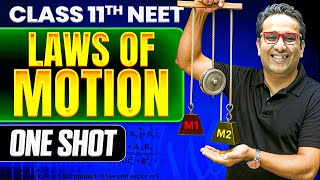
Laws of Motion in One Shot | PW NEET | Saleem Ahmad Sir
This note provides a comprehensive overview of the YouTube video "LAWS OF MOTION in ONE SHOT | All Concepts & PYQs | Basics to Advanced | Class 11 NEET" by Saleem Ahmad Sir on the PW NEET channel.
---
1. Summary
This lecture provides a thorough one-shot coverage of the Laws of Motion for Class 11 NEET aspirants. It begins with an introduction to the fundamental concepts, including Newton's three laws of motion, and then delves into various types of forces such as gravitational, tension, and normal forces. The video explains equilibrium and its applications, including pulley systems (Atwood machines). It extensively covers the application of Newton's second law (F=ma) with numerous solved problems. Advanced topics like spring force, pseudo force, and the method of virtual work are also discussed with corresponding practice questions. The lecture concludes with specific questions on rocket propulsion.
---
2. Key Takeaways
* **Newton's Laws of Motion are foundational:** The video systematically explains the First Law (Inertia), Second Law (F=ma), and Third Law (Action-Reaction).
* **Understanding Forces is Crucial:** A detailed explanation of different forces (Gravitational, Tension, Normal) and their behavior is provided.
* **Equilibrium and its Applications:** The concept of equilibrium is explained, followed by its application in pulley systems (Atwood machines) and general scenarios with numerous examples.
* **F=ma is the core equation:** The lecture emphasizes the practical application of the second law (F=ma) in solving a wide range of problems, from simple to complex.
* **Advanced Concepts Covered:** Pseudo Force (for non-inertial frames), Spring Force, and the Virtual Work Method are introduced with illustrative examples.
* **Problem-Solving Focus:** A significant portion of the lecture is dedicated to solving Previous Year Questions (PYQs) and practice problems to solidify understanding.
* **Specific Applications:** Rocket propulsion is addressed as a key application of the laws of motion.
---
3. Detailed Notes
**00:00:00 - Introduction**
* Welcome and overview of the session.
**00:02:02 - Channel Information**
* Information about the PW NEET channel.
**00:02:31 - Topics to be covered: Newton Laws of Motion**
* Outline of the lecture: Newton's Laws, types of forces, equilibrium, pulley systems, F=ma applications, spring force, pseudo force, virtual work, rocket propulsion.
**00:07:25 - Newton Laws of Motion: 1st-Law of Inertia, 2nd Law, 3rd Law**
* **First Law (Law of Inertia):**
* An object at rest stays at rest, and an object in motion stays in motion with the same speed and in the same direction unless acted upon by an unbalanced external force.
* Inertia: Tendency of an object to resist changes in its state of motion.
* Types of Inertia: Inertia of rest, inertia of motion, inertia of direction.
* Examples: Bus suddenly starting/stopping, a book on a table.
* **Second Law:**
* The rate of change of momentum of an object is directly proportional to the applied unbalanced force and takes place in the direction of the force.
* **Mathematical Formula: F = dp/dt = m * dv/dt = m * a**
* **F = ma**: Force equals mass times acceleration. This is the most crucial equation in mechanics.
* **Momentum (p):** p = mv
* **Third Law:**
* For every action, there is an equal and opposite reaction.
* Forces always occur in pairs.
* Action and reaction forces act on different bodies.
* Examples: Walking, rocket propulsion, recoil of a gun.
**00:16:25 - Force: Gravitational Force, Tension Force, Normal Force**
* **Gravitational Force (Weight):**
* The force of attraction between any two objects with mass.
* Near the Earth's surface, it's the weight of the object: W = mg, where 'g' is the acceleration due to gravity.
* Weight acts vertically downwards.
* **Tension Force (T):**
* A force transmitted through a string, rope, cable, or wire when it is pulled tight by forces that tend to stretch or extend it.
* Tension acts along the string/rope.
* In ideal strings (massless and inextensible), tension is the same throughout.
* **Normal Force (N):**
* A contact force exerted by a surface on an object.
* It is perpendicular to the surface.
* It is a reaction force to the force exerted by the object on the surface.
* Magnitude depends on the situation (e.g., on a horizontal surface, N = mg; on an inclined plane, N = mg cosθ).
**00:27:38 - Equilibrium**
* **Definition:** An object is in equilibrium when the net force acting on it is zero. This means the object is either at rest or moving with a constant velocity.
* **Conditions for Equilibrium:**
* **Translational Equilibrium:** Sum of forces in x, y, and z directions are zero (ΣFx = 0, ΣFy = 0, ΣFz = 0).
* **Rotational Equilibrium:** Sum of torques about any point is zero (Στ = 0). (Often simplified to Fx = 0, Fy = 0 for 2D problems).
**00:28:18 - Questions on Equilibrium**
* (Problems involving blocks on surfaces, connected objects, and forces balancing each other are discussed and solved here).
* Examples: Block on a rough horizontal surface, system of blocks connected by strings.
**00:55:08 - Pulley System / Atwood Machine**
* **Atwood Machine:** A simple device consisting of two masses connected by a string passing over a frictionless pulley.
* **Analysis:**
* Draw Free Body Diagrams (FBDs) for each mass.
* Apply Newton's Second Law (F=ma) to each mass.
* Assume acceleration (a) and tension (T).
* Solve the system of equations to find 'a' and 'T'.
* For two masses m1 and m2 (m2 > m1) connected by a light inextensible string over a light frictionless pulley:
* Acceleration: `a = g * (m2 - m1) / (m1 + m2)`
* Tension: `T = 2 * m1 * m2 * g / (m1 + m2)`
**01:04:46 - Questions on Equilibrium (Continued) & Pulley Systems**
* (More problems on equilibrium and pulley systems, including cases with multiple pulleys and inclined planes).
* Examples: A system with a fixed pulley and a movable pulley, blocks on inclined planes connected by a string.
**01:20:42 - Application of F=ma**
* **General Approach:**
1. **Identify the system:** What object(s) are we analyzing?
2. **Draw Free Body Diagrams (FBDs):** Show all forces acting on each object.
3. **Choose a coordinate system:** Usually, align axes with motion or perpendicular to surfaces.
4. **Apply Newton's Second Law (F=ma) to each object/component of motion.**
5. **Solve the resulting equations.**
* **Examples covered:**
* Blocks on horizontal and inclined planes (smooth and rough).
* Systems involving multiple connected blocks.
* Problems with friction.
* Force diagrams for objects at rest or accelerating.
**01:32:22 - Questions**
* (A series of practice problems applying F=ma are solved, covering various scenarios).
**02:08:12 - Spring Force**
* **Hooke's Law:** The force exerted by a spring is directly proportional to its displacement from its equilibrium position and acts in the opposite direction of the displacement.
* **Mathematical Formula: F_spring = -kx**
* k: Spring constant (stiffness of the spring).
* x: Displacement from the equilibrium position.
* The negative sign indicates that the force is restoring.
* **Potential Energy stored in a spring: U = (1/2)kx²**
* **Applications:** Spring-mass systems, springs in mechanical devices.
* (Problems involving springs attached to masses, stretching and compressing).
**02:40:12 - Pseudo Force (Fictitious Force)**
* **Context:** When analyzing motion in a **non-inertial frame of reference** (an accelerating frame).
* **Definition:** A force that appears to exist in a non-inertial frame, but is actually a consequence of the frame's acceleration. It's not a real force arising from interaction between objects.
* **Magnitude and Direction:** Equal to `m * a_frame`, where 'm' is the mass of the object and `a_frame` is the acceleration of the non-inertial frame. It acts in the direction opposite to the acceleration of the frame.
* **Formula (in a non-inertial frame):** `F_real + F_pseudo = m * a_relative`
* `F_real`: Actual forces acting on the object.
* `F_pseudo = -m * a_frame`
* `a_relative`: Acceleration of the object as observed from the non-inertial frame.
* **Examples:**
* Person in an accelerating lift.
* Object on a rotating platform.
* Pendulum in an accelerating bus.
**02:55:57 - Questions on Pseudo Force**
* (Problems solved involving situations where pseudo force is relevant).
* Examples: A block kept on a wedge accelerating horizontally, a mass in an accelerating lift.
**03:31:30 - Virtual Work Method**
* **Concept:** A method to analyze equilibrium of mechanical systems. It states that for a system in equilibrium, the total virtual work done by all forces (including external and constraint forces if they do no work) is zero for any virtual displacement.
* **Virtual Displacement:** An imaginary, infinitesimal displacement that is consistent with the constraints of the system.
* **Work Done:** W = F ⋅ dr
* **Application:** Useful for systems with rigid bodies, linkages, and complex constraints. It can simplify problems where forces are difficult to determine or directly apply F=ma.
**03:38:50 - Questions**
* (Practice problems covering various topics, potentially including applications of virtual work, or more complex F=ma scenarios).
**04:26:08 - Rocket Propulsion Questions**
* **Princ:** Based on Newton's Third Law (action-reaction) and conservation of momentum.
* **Mechanism:** A rocket expels mass (fuel) at high velocity backwards, generating a forward thrust (reaction force).
* **Force Equation:** Thrust (F_thrust) = rate of change of momentum of expelled mass = `v_e * (dm/dt)`, where `v_e` is the exhaust velocity and `dm/dt` is the rate of mass expulsion.
* **Equation of Motion for Rocket:** `m * (dv/dt) = v_e * (dm/dt) - mg` (considering gravity).
* (Problems involving calculating thrust, acceleration, and changes in velocity for rockets).
**04:33:44 - Thank You**
* Concluding remarks and calls to action.
Related Summaries
![[캡컷PC]0015-복합클립만들기분리된영상 하나로 만들기](https://img.youtube.com/vi/qtUfil0xjCs/mqdefault.jpg)

Why this video matters
This video provides valuable insights into the topic. Our AI summary attempts to capture the core message, but for the full nuance and context, we highly recommend watching the original video from the creator.
Disclaimer: This content is an AI-generated summary of a public YouTube video. The views and opinions expressed in the original video belong to the content creator. YouTube Note is not affiliated with the video creator or YouTube.