Learn HTML & CSS – Full Course for Beginners
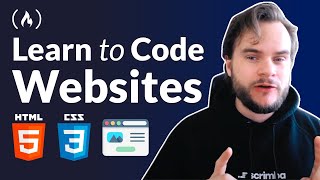
HTML & CSS Full Course for Beginners - freeCodeCamp.org
This comprehensive course, created by Per Harald Borgen (co-founder of Scrimba), teaches HTML and CSS from scratch by building **six projects** and solving over **80 coding challenges**. It utilizes an interactive browser-based format via Scrimba.
**Resources:**
* **Interactive Version:** [https://scrimba.com/links/htmlandcss](https://scrimba.com/links/htmlandcss)
* **GitHub Repo:** [https://github.com/scrimba/learn-html...](https://github.com/scrimba/learn-html...)
* **Creator's Twitter:** /perborgen
* **Tools Used:** Netlify, VS Code, GitHub Desktop, Figma, Coolors, Google Fonts, 1001 Fonts
---
1. Summary
This course provides a hands-on introduction to web development fundamentals: HTML for structuring content and CSS for styling it. Through building six distinct projects, learners will gain practical experience in creating and styling various web elements, understanding document structure, implementing interactive features, and deploying their creations. The course emphasizes an interactive learning approach, encouraging learners to build and experiment.
---
2. Key Takeaways
* **HTML:** The backbone of web pages, used for creating content structure (headings, paragraphs, images, links, lists, buttons, input fields).
* **CSS:** The styling language that controls the visual presentation of HTML elements (colors, fonts, spacing, layout, borders, shadows).
* **Project-Based Learning:** The course utilizes six projects to reinforce concepts through practical application.
* **Interactive Learning:** The Scrimba platform offers an interactive experience, allowing users to code along and experiment.
* **Essential Web Development Tools:** Familiarity with tools like VS Code, Netlify, and GitHub is beneficial.
* **Understanding Selectors:** CSS selectors (tags, classes, IDs) are crucial for targeting and styling specific HTML elements.
* **Box Model:** Understanding `margin`, `padding`, and `border` is fundamental to controlling spacing and layout.
* **Display Properties:** `inline` vs. `block` elements and `flexbox` are key for arranging content.
* **Deployment:** The course covers deploying finished websites using services like Netlify.
---
3. Detailed Notes
**Module 1: Build and deploy your first website**
* **Introduction:** Welcome to HTML & CSS.
* **HTML Tags:**
* Basic structure of HTML: `<!DOCTYPE html>`, `<html>`, `<head>`, `<body>`.
* Common tags: `<h1>` to `<h6>` (headings), `<p>` (paragraph), `<a>` (anchor/link), `<img>` (image), `<button>`, `<input>`.
* **Building a News Article:** Using headings, paragraphs, and semantic tags.
* **Image Tag (`<img>`):**
* `src` attribute: specifies the image source.
* `alt` attribute: provides alternative text for accessibility and SEO.
* **Nesting:** Placing HTML elements inside other elements to create structure (e.g., a `<div>` containing paragraphs).
* **Interactive Elements:**
* **Button (`<button>`):** Creates clickable buttons.
* **Input Tags (`<input>`):** Used for user input.
* Various `type` attributes: `text`, `password`, `email`, `number`, `submit`, `checkbox`, `radio`.
* **Building Google.com (Basic Structure):** Demonstrates layout using basic tags.
* **Anchor Tags (`<a>`):**
* `href` attribute: specifies the link's destination.
* Linking to external websites (e.g., `https://www.google.com`).
* **Proper Document Structure:** Importance of semantic HTML for readability and accessibility.
* **Lists:**
* Ordered lists (`<ol>`).
* Unordered lists (`<ul>`).
* List items (`<li>`).
* **Project: Build a Personal Website:** Consolidating HTML knowledge.
* **Deploy your Personal Website:** Using Netlify for deployment.
* **HTML Recap:** Review of core HTML concepts.
**Module 2: Build a Google.com clone**
* **Introduction to CSS:** What is CSS and how it's used.
* **Writing your first CSS:**
* CSS syntax: `selector { property: value; }`.
* Styling elements (e.g., changing text color, font size).
* **Linking CSS Files:**
* Using the `<link>` tag in the HTML `<head>`: `<link rel="stylesheet" href="style.css">`.
* **Styling Elements:**
* **Width:** `width` property to control element width.
* **Inline vs. Block Elements:**
* `inline`: Takes only necessary width, flows with text.
* `block`: Takes full width, starts on a new line.
* **Margin:** `margin-top`, `margin-right`, `margin-bottom`, `margin-left` for spacing outside an element.
* **Divs (`<div>`):** Generic container elements for grouping and styling.
* **CSS Classes (`.`):** Applying styles to multiple elements using a shared class name.
* **IDs (`#`):** Applying styles to a unique element.
* **Spacing and Layout:**
* **Margin:** Controlling space *between* elements.
* **Centering with Margins:** Using `margin: 0 auto;` for block-level elements.
* **Padding:** `padding` for space *inside* an element, between content and border.
* **Border and Border-Radius:** `border` for outlines, `border-radius` for rounded corners.
* **Project: Style Twitter Button:** Applying learned CSS properties.
* **Fixing Input Fields:** Styling input elements.
* **Centering and Styling Buttons:** Using CSS to align and visually enhance buttons.
* **Flexbox:**
* `display: flex;`: A powerful layout module for arranging items in rows or columns.
* `justify-content`: Aligns items along the main axis.
* `align-items`: Aligns items along the cross axis.
* `flex-direction`: Controls the direction of flex items (row or column).
* **Google Clone Recap:** Consolidating CSS skills for layout.
**Module 3: Build a Digital Business Card**
* **Project: Digital Business Card:** Creating a personal online business card.
* **Image Path Issues:** Ensuring correct paths for images.
* **Alt Attribute:** Reinforcing accessibility and SEO.
* **Image Sizing:** Using CSS to control image dimensions.
* **Borders and Padding:** Styling the card's appearance.
* **Flexbox for Layout:**
* Flexbox child containers.
* Flex item containers.
* **Utility Classes:** Creating reusable CSS classes (e.g., for centering).
* **Justifying Items:** Using flexbox for alignment.
* **Centering the Card:** Employing flexbox to center the card on the page.
* **Inheritance:** How CSS properties can be inherited by child elements.
* **Centering Text:** Using inheritance or other methods.
* **Colors:** Applying color to text and backgrounds.
* **Web-Safe Fonts:** Understanding fonts that are generally available across different systems.
* **Margin/Padding Shorthand:** Using concise properties (e.g., `margin: 10px 20px;`).
* **Deploy your Digital Business Card:** Another deployment practice.
* **Business Card Recap:** Reviewing the project's learned concepts.
**Module 4: Build a Space Exploration Site**
* **Project: Space Exploration Site:** Creating a thematic website.
* **Background Images:** Using `background-image` from sources like Unsplash.
* **Centering Elements and Styling Buttons:** Combining layout and styling.
* **Google Fonts:** Importing and using custom fonts from Google Fonts.
* **`@font-face`:** Custom font declaration for fonts not available via services.
* **Spans (`<span>`):** Inline containers for styling specific parts of text.
* **Underlines with Spans:** Demonstrating inline styling.
* **IDs for Logos:** Using IDs for unique elements like logos.
* **Image Formats:** Replacing JPG with WebP for better performance.
* **Color Palettes:** Choosing colors effectively, potentially from an image.
* **Terms & Conditions Section:** Structuring longer content.
* **Text Shadow:** `text-shadow` property for enhancing text readability and visual appeal.
* **Space Exploration Recap:** Summarizing the project.
**Module 5: Build a Birthday GIFt Site**
* **Project: Birthday GIFt Site:** Designing a festive website.
* **Header Styling:** Applying styles to the main navigation or title area.
* **Color Schemes:** Setting and applying colors.
* **Text Shadows:** Adding visual depth to text.
* **Flexbox for Layout Problems:** Using flexbox to solve layout challenges.
* **`align-items`:** Aligning flex items along the cross-axis.
* **`flex-direction`:** Changing the orientation of flex items.
* **Transforming Header with Flexbox:** Applying flexbox to the header.
* **Date and Age Design:** Styling specific date and age elements.
* **Creating Gifts (HTML Structure):** Building individual gift sections.
* **Replacing `<img>` with `<div>`:** Using divs for more complex styling or as containers.
* **Hover Effects:** Using the `:hover` pseudo-class to change element appearance when the mouse is over it.
* **Creating Multiple Gifts:** Replicating and adapting gift sections.
* **Footer Styling:** Adding and styling the website's footer.
* **Background Gradients:** Creating smooth color transitions for backgrounds.
* **Personalization:** Tips for customizing the site.
* **Using GitHub Desktop:** Publishing the site using GitHub Desktop.
* **Deployment:** Deploying the Birthday GIFt Site.
* **Using VS Code:** Editing HTML and CSS files.
* **GIFt Site Recap:** Reviewing the project.
**Module 6: Solo Project: Hometown Homepage**
* **Going Solo:** Encouragement to apply learned skills independently.
* **Solo Project - Hometown Homepage:** A final project to build independently.
* **Course Completion:** Congratulations and next steps.
Related Summaries
![[캡컷PC]0015-복합클립만들기분리된영상 하나로 만들기](https://img.youtube.com/vi/qtUfil0xjCs/mqdefault.jpg)
Why this video matters
This video provides valuable insights into the topic. Our AI summary attempts to capture the core message, but for the full nuance and context, we highly recommend watching the original video from the creator.
Disclaimer: This content is an AI-generated summary of a public YouTube video. The views and opinions expressed in the original video belong to the content creator. YouTube Note is not affiliated with the video creator or YouTube.