LECCIÓN 7: EXPLICACIÓN DEL PRESENTE SIMPLE - CÓMO USAR EL PRESENTE SIMPLE EN INGLES | SIMPLE PRESENT
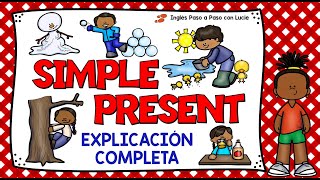
LECCIÓN 7: EXPLICACIÓN DEL PRESENTE SIMPLE - CÓMO USAR EL PRESENTE SIMPLE EN INGLES | SIMPLE PRESENT
Summary
This lesson from "Inglés Paso a Paso con Lucie" provides a comprehensive explanation of the Simple Present tense in English. It covers how to form affirmative sentences, negative sentences, and questions. Crucially, it explains the correct usage of the auxiliary verbs "Do" and "Does," emphasizing their role in negation and question formation, and how they impact verb conjugation. The video also briefly touches upon the common uses of the Simple Present, such as for habits, routines, facts, and general truths.
Key Takeaways
* The Simple Present is used for habits, routines, facts, and general truths.
* **Affirmative Sentences:** For most subjects (I, you, we, they), the base form of the verb is used. For third-person singular subjects (he, she, it), add "-s," "-es," or "-ies" to the verb.
* **Negative Sentences:** Use the auxiliary "Do" or "Does" followed by "not" and the base form of the verb.
* "Do not" (don't) is used with I, you, we, they.
* "Does not" (doesn't) is used with he, she, it.
* **Questions:** Use the auxiliary "Do" or "Does" at the beginning of the sentence, followed by the subject and the base form of the verb.
* "Do" is used with I, you, we, they.
* "Does" is used with he, she, it.
* When using "Do" or "Does" in negatives and questions, the main verb reverts to its base form (no "-s," "-es," or "-ies" ending).
Detailed Notes
1. Introduction to the Simple Present
* **Purpose:** Used to talk about things that happen regularly, things that are always true, or general facts.
* **Habits and Routines:** *I wake up at 7 AM every day.*
* **Facts and General Truths:** *The sun rises in the east.*
* **States of Being:** *She likes chocolate.*
2. Affirmative Sentences
* **General Rule:** For most subjects, use the base form of the verb.
* *I play football.*
* *You study English.*
* *We live in a big city.*
* *They watch movies.*
* **Third-Person Singular (He, She, It):** Add "-s," "-es," or "-ies" to the verb.
* **Adding -s:**
* *He play**s** football.*
* *She like**s** pizza.*
* *It rain**s** a lot here.*
* **Adding -es (verbs ending in -s, -ss, -sh, -ch, -x, -o):**
* *He wa**shes** his car.*
* *She watch**es** TV.*
* *He go**es** to school.*
* *He bu**shes** his teeth.*
* **Adding -ies (verbs ending in consonant + y):**
* *She stud**ies** English.*
* *He carr**ies** his bag.*
* **Verbs ending in vowel + y:** Just add -s.
* *He play**s**.* (Note: *play* is listed above as an example with just -s, but this rule clarifies the pattern.)
3. Negative Sentences
* **Auxiliary Verbs:** "Do" and "Does" are essential for forming negatives.
* **Structure:** Subject + **Do/Does + NOT** + Base Form of the Verb
* **Contractions:**
* Do not = **Don't**
* Does not = **Doesn't**
* **Usage with Subjects:**
* **I, You, We, They:** Use **Do not (Don't)**
* *I **do not** (don't) play football.*
* *You **don't** study English.*
* *We **don't** live in a big city.*
* *They **don't** watch movies.*
* **He, She, It:** Use **Does not (Doesn't)**
* *He **does not** (doesn't) play football.* (Note: "plays" becomes "play")
* *She **doesn't** study English.* (Note: "studies" becomes "study")
* *It **doesn't** rain a lot here.* (Note: "rains" becomes "rain")
* **Crucial Point:** When using "Do" or "Does" in negative sentences, the main verb **always** returns to its base form. The "-s," "-es," or "-ies" ending is removed.
4. Questions (Yes/No Questions)
* **Auxiliary Verbs:** "Do" and "Does" are used to start questions.
* **Structure:** **Do/Does** + Subject + Base Form of the Verb?
* **Usage with Subjects:**
* **I, You, We, They:** Start with **Do**
* ***Do** I play football?*
* ***Do** you study English?*
* ***Do** we live in a big city?*
* ***Do** they watch movies?*
* **He, She, It:** Start with **Does**
* ***Does** he play football?* (Note: "plays" becomes "play")
* ***Does** she study English?* (Note: "studies" becomes "study")
* ***Does** it rain a lot here?* (Note: "rains" becomes "rain")
* **Crucial Point:** Similar to negatives, when using "Do" or "Does" in questions, the main verb **always** returns to its base form.
5. Wh- Questions (Information Questions)
* These questions start with question words like "What," "Where," "When," "Why," "Who," "How."
* **Structure:** Wh- word + **Do/Does** + Subject + Base Form of the Verb?
* *What **do** you study?*
* *Where **does** she live?*
* *When **do** they play?*
6. Common Errors to Avoid
* Forgetting to add "-s," "-es," or "-ies" to verbs with he, she, it in affirmative sentences.
* Forgetting to revert the verb to its base form when using "don't" or "doesn't."
* Forgetting to start questions with "Do" or "Does" and revert the verb to its base form.
* Using "Do" instead of "Does" for he, she, it, and vice versa.
---
* **Free Study Guide Download:** [https://www.inglespasoapasoconlucie.c...](https://www.inglespasoapasoconlucie.c...)
* **Graphics Provided By:** [https://www.inglespasoapasoconlucie.c...](https://www.inglespasoapasoconlucie.c...)
* **Usage Rights:** Material is for personal use and cannot be sold or used commercially without written authorization.
Related Summaries
![[캡컷PC]0015-복합클립만들기분리된영상 하나로 만들기](https://img.youtube.com/vi/qtUfil0xjCs/mqdefault.jpg)
Why this video matters
This video provides valuable insights into the topic. Our AI summary attempts to capture the core message, but for the full nuance and context, we highly recommend watching the original video from the creator.
Disclaimer: This content is an AI-generated summary of a public YouTube video. The views and opinions expressed in the original video belong to the content creator. YouTube Note is not affiliated with the video creator or YouTube.