Lecture # 3 Redox Reaction.
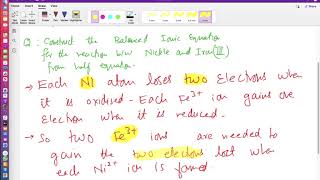
Lecture #3: Redox Reactions (ChemBridge)
1. Summary
This lecture introduces the fundamental concepts of redox reactions, also known as oxidation-reduction reactions. It explains that these reactions involve the transfer of electrons between chemical species. The core of the lecture focuses on defining oxidation and reduction, identifying oxidizing and reducing agents, and understanding how to assign oxidation states to elements within compounds. The lecture provides practical methods for balancing redox reactions, particularly in acidic and basic solutions, which are crucial skills in chemistry.
2. Key Takeaways
* **Redox Reactions:** Chemical reactions involving the transfer of electrons.
* **Oxidation:** The **loss** of electrons, accompanied by an **increase** in oxidation state.
* **Reduction:** The **gain** of electrons, accompanied by a **decrease** in oxidation state.
* **Oxidizing Agent (Oxidant):** The species that **causes** oxidation by being **reduced** itself.
* **Reducing Agent (Reductant):** The species that **causes** reduction by being **oxidized** itself.
* **Oxidation State (Oxidation Number):** A hypothetical charge assigned to an atom in a molecule or ion, assuming all bonds are ionic.
* **Balancing Redox Reactions:** Essential for accurately representing chemical changes. Methods include the oxidation state method and the half-reaction method.
* **Balancing in Acidic and Basic Solutions:** Specific steps are required to account for the presence of H+ (acidic) or OH- (basic) ions.
3. Detailed Notes
I. Introduction to Redox Reactions
* **Definition:** Reactions where oxidation and reduction occur simultaneously.
* **Electron Transfer:** The defining characteristic of redox reactions.
* **Mnemonic:** "OIL RIG" - Oxidation Is Loss, Reduction Is Gain.
II. Oxidation and Reduction Defined
* **Oxidation:**
* Loss of electrons.
* Increase in oxidation state.
* Example: Na (0) → Na+ (+1) + e-
* **Reduction:**
* Gain of electrons.
* Decrease in oxidation state.
* Example: Cl2 (0) + 2e- → 2Cl- (-1)
III. Oxidizing and Reducing Agents
* **Oxidizing Agent (Oxidant):**
* The species that oxidizes another species.
* It accepts electrons and is itself reduced.
* Example: Cl2 in the reaction Na + Cl2 → NaCl. Cl2 is reduced, so it's the oxidizing agent.
* **Reducing Agent (Reductant):**
* The species that reduces another species.
* It donates electrons and is itself oxidized.
* Example: Na in the reaction Na + Cl2 → NaCl. Na is oxidized, so it's the reducing agent.
IV. Assigning Oxidation States (Oxidation Numbers)
* **Rules for Assigning Oxidation States:**
1. **Elements in their elemental form:** Oxidation state is 0 (e.g., O2, Na, Fe).
2. **Monatomic ions:** Oxidation state is equal to the charge of the ion (e.g., Na+ is +1, Cl- is -1).
3. **Oxygen:** Usually -2 in compounds, except in peroxides (e.g., H2O2 where O is -1) and when bonded to fluorine (e.g., OF2 where O is +2).
4. **Hydrogen:** Usually +1 when bonded to nonmetals, and -1 when bonded to metals (hydrides, e.g., NaH).
5. **Fluorine:** Always -1 in compounds.
6. **Group 1 metals (Alkali Metals):** Always +1 in compounds.
7. **Group 2 metals (Alkaline Earth Metals):** Always +2 in compounds.
8. **The sum of oxidation states in a neutral compound is 0.**
9. **The sum of oxidation states in a polyatomic ion equals the charge of the ion.**
* **Examples:**
* H2SO4: H(+1)x2 + S(?) + O(-2)x4 = 0 → +2 + S - 8 = 0 → S = +6
* Cr2O7^2-: Cr(?)x2 + O(-2)x7 = -2 → 2Cr - 14 = -2 → 2Cr = +12 → Cr = +6
V. Balancing Redox Reactions
* **Importance:** To satisfy the law of conservation of mass and charge.
* **Methods:**
1. **Oxidation State Method:**
* Assign oxidation states to all atoms.
* Identify the species being oxidized and reduced.
* Balance the increase/decrease in oxidation states by multiplying coefficients.
* Balance atoms other than O and H.
* Balance O atoms by adding H2O.
* Balance H atoms by adding H+.
* Check for charge balance and atom balance.
2. **Half-Reaction Method:**
* **Step 1: Separate into half-reactions.** Write the oxidation half-reaction and the reduction half-reaction.
* **Step 2: Balance atoms other than O and H.**
* **Step 3: Balance O atoms by adding H2O.**
* **Step 4: Balance H atoms by adding H+ (for acidic solutions).**
* **Step 5: Balance the charge in each half-reaction by adding electrons (e-).**
* **Step 6: Multiply each half-reaction by a suitable integer** so that the number of electrons lost in the oxidation half-reaction equals the number of electrons gained in the reduction half-reaction.
* **Step 7: Add the balanced half-reactions together.**
* **Step 8: Simplify the equation** by canceling out any species that appear on both sides.
* **Step 9: Check the final equation** for atom and charge balance.
#### A. Balancing in Acidic Solution (using Half-Reaction Method as an example)
* **Example:** MnO4- + SO2 → Mn2+ + SO4^2- (acidic)
* **Oxidation Half-Reaction:** SO2 → SO4^2-
* S: Already balanced.
* O: SO2 + 2H2O → SO4^2-
* H: SO2 + 2H2O → SO4^2- + 4H+
* Charge: SO2 + 2H2O → SO4^2- + 4H+ + 2e-
* **Reduction Half-Reaction:** MnO4- → Mn2+
* Mn: Already balanced.
* O: MnO4- → Mn2+ + 4H2O
* H: MnO4- + 8H+ → Mn2+ + 4H2O
* Charge: MnO4- + 8H+ + 5e- → Mn2+ + 4H2O
* **Multiply:**
* Oxidation: (SO2 + 2H2O → SO4^2- + 4H+ + 2e-) x 5
* Reduction: (MnO4- + 8H+ + 5e- → Mn2+ + 4H2O) x 2
* **Add and Simplify:**
* 5SO2 + 10H2O + 2MnO4- + 16H+ + 10e- → 5SO4^2- + 20H+ + 10e- + 2Mn2+ + 8H2O
* **5SO2 + 2H2O + 2MnO4- → 5SO4^2- + 4H+ + 2Mn2+** (after canceling 10e-, 8H2O, and 16H+)
* **Check:** Atoms: S(5), O(10+8=18), H(4), Mn(2). Charge: -2 + 16 - 10 = +4 on left. S(5), O(20), H(4), Mn(2). Charge: -10 + 8 = -2 on right. (Error in manual calculation or lecture example interpretation. Should re-verify specific balancing steps from lecture).
#### B. Balancing in Basic Solution
* **Procedure:**
* Balance the reaction as if it were in acidic solution first.
* For every H+ ion present, add an equal number of OH- ions to **both sides** of the equation.
* Combine H+ and OH- on the same side to form H2O.
* Simplify by canceling out any extra H2O molecules.
* **Example:** If the balanced acidic equation has 4H+, add 4OH- to both sides.
* 4H+ + 4OH- → 4H2O
* If there are H2O on the reactant side, they will cancel with some of the newly formed H2O on the product side.
VI. Importance and Applications of Redox Reactions
* **Combustion:** Burning fuels (e.g., hydrocarbons).
* **Corrosion:** Rusting of iron, tarnishing of silver.
* **Batteries and Electrochemistry:** Generating electricity through controlled redox reactions.
* **Biological Processes:** Respiration, photosynthesis.
* **Industrial Processes:** Metallurgy, synthesis of chemicals.
Related Summaries
![[캡컷PC]0015-복합클립만들기분리된영상 하나로 만들기](https://img.youtube.com/vi/qtUfil0xjCs/mqdefault.jpg)

Why this video matters
This video provides valuable insights into the topic. Our AI summary attempts to capture the core message, but for the full nuance and context, we highly recommend watching the original video from the creator.
Disclaimer: This content is an AI-generated summary of a public YouTube video. The views and opinions expressed in the original video belong to the content creator. YouTube Note is not affiliated with the video creator or YouTube.