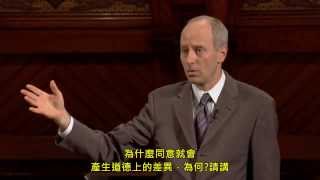
哈佛開放課程:正義:一場思辨之旅 Michael Sandel Justice:What's The Right Thing To Do 第一集
Here is a comprehensive and structured note based on the provided YouTube video information:
Michael Sandel's Justice: What's the Right Thing to Do? - Episode 1
**Summary:**
This first episode of Michael Sandel's "Justice: What's the Right Thing to Do?" course, translated by Chu Hsueh-heng, introduces the fundamental question of justice. Sandel explores how we grapple with moral dilemmas, using real-world examples and historical philosophical frameworks. He begins by presenting a hypothetical scenario involving a runaway trolley to illustrate the complexities of ethical decision-making, highlighting the tension between utilitarian principles (maximizing good for the greatest number) and deontological considerations (duties and rights). The episode sets the stage for a deeper exploration of various theories of justice throughout the course.
**Key Takeaways:**
* **The Nature of Justice:** Justice is not a simple concept; it involves complex moral reasoning and often conflicting principles.
* **Moral Dilemmas:** Real-life situations frequently present us with difficult choices where no outcome is perfectly ideal.
* **Utilitarianism:** This philosophy suggests that the morally right action is the one that produces the greatest good for the greatest number of people.
* **Deontology:** This perspective emphasizes duties, rights, and the inherent moral worth of individuals, arguing that some actions are wrong regardless of their consequences.
* **The Role of Reason in Ethics:** Sandel emphasizes the importance of critical thinking and reasoned argument in navigating ethical questions.
* **The Trolley Problem:** This classic thought experiment is used to explore the differences between consequentialist and deontological approaches to morality.
**Detailed Notes:**
I. Introduction to the Course and the Question of Justice
* **Course Title:** Justice: What's the Right Thing to Do? (哈佛開放課程:正義:一場思辨之旅)
* **Instructor:** Michael Sandel
* **Translator:** Chu Hsueh-heng (朱學恆)
* **Core Question:** What is justice? What is the right way to organize society? What is the right thing to do?
* **Approach:** Explores justice through thought experiments, real-world examples, and philosophical traditions.
* **Emphasis:** Encourages critical thinking and reasoned moral debate.
II. The Runaway Trolley Problem: A Gateway to Ethical Dilemmas
* **Scenario 1: The Switch**
* A runaway trolley is hurtling down the tracks.
* Ahead, five people are tied to the tracks.
* You are standing next to a lever.
* If you pull the lever, the trolley will switch to a different track.
* However, on this side track, one person is tied.
* **Dilemma:** Do you pull the lever, resulting in one death but saving five? Or do you do nothing, allowing five to die?
* **Scenario 2: The Fat Man**
* Same runaway trolley heading towards five people.
* This time, you are standing on a bridge over the tracks next to a very large man.
* You realize that if you push the man off the bridge, his body will stop the trolley, saving the five people.
* However, the man will die.
* **Dilemma:** Do you push the man, saving five but causing his death?
* **Comparison of Scenarios:**
* Both scenarios involve sacrificing one person to save five.
* However, many people feel it is permissible to pull the lever but wrong to push the man.
* **Why the difference?** This highlights the intuitive moral distinctions we make.
III. Exploring Philosophical Frameworks
* **Utilitarianism (Consequentialism):**
* **Core Principle:** The greatest good for the greatest number.
* **Application:** In the trolley problem, utilitarianism would suggest pulling the lever and pushing the man, as this action maximizes overall well-being (saving five lives at the cost of one).
* **Challenges:** Can lead to the violation of individual rights or deeply held moral intuitions if it serves the greater good.
* **Deontology:**
* **Core Principle:** Focuses on duties, rights, and the intrinsic moral value of actions, irrespective of consequences.
* **Application:** Might argue against pushing the man because it involves using him as a mere means to an end, violating his autonomy and dignity. The act of killing is intrinsically wrong.
* **Connection to Kant:** Later episodes will likely delve into Kantian ethics, which strongly emphasizes these deontological principles.
IV. The Importance of Moral Reasoning
* **Beyond Gut Feelings:** Sandel encourages moving beyond instinctive reactions to a deeper, reasoned understanding of our moral judgments.
* **Public Debate:** Justice requires open discussion and the articulation of reasons for our beliefs.
* **The Goal:** To refine our moral intuitions and arrive at more coherent and justifiable principles for organizing society.
V. Next Steps in the Course
* This episode serves as an introduction, setting the stage for exploring various theories of justice in depth.
* Future episodes will likely cover:
* Rawls's Theory of Justice (veil of ignorance)
* Libertarianism
* Kant's moral philosophy
* The ethics of markets and discrimination
* The role of civic virtue and the common good.
Related Summaries
![[캡컷PC]0015-복합클립만들기분리된영상 하나로 만들기](https://img.youtube.com/vi/qtUfil0xjCs/mqdefault.jpg)
Why this video matters
This video provides valuable insights into the topic. Our AI summary attempts to capture the core message, but for the full nuance and context, we highly recommend watching the original video from the creator.
Disclaimer: This content is an AI-generated summary of a public YouTube video. The views and opinions expressed in the original video belong to the content creator. YouTube Note is not affiliated with the video creator or YouTube.