Nitrogen cycle || nitrogen fixation || what is nitrogen cycle
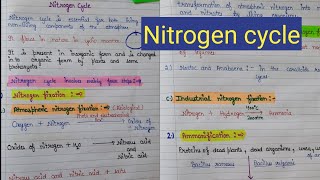
Here's a structured note based on the provided YouTube video information about the nitrogen cycle:
The Nitrogen Cycle: A Comprehensive Overview
This document summarizes the key concepts presented in the "Nitrogen cycle || nitrogen fixation || what is nitrogen cycle" video from the Mishri education storer channel.
---
1. Summary
The video explains the crucial **nitrogen cycle**, a biogeochemical process that describes how nitrogen atoms move through the Earth's biosphere, atmosphere, and lithosphere. It emphasizes the importance of nitrogen as a fundamental building block for life, essential for proteins, nucleic acids (DNA and RNA), and other vital organic molecules. The video specifically delves into **nitrogen fixation**, the process of converting atmospheric nitrogen gas (N₂) into usable forms for plants, highlighting both biological and industrial methods. It also touches upon the various stages within the nitrogen cycle, including ammonification, nitrification, and denitrification, and the roles of microorganisms in these transformations.
---
2. Key Takeaways
* **Nitrogen is Essential for Life:** Nitrogen is a vital element for all living organisms, forming the basis of proteins, DNA, and RNA.
* **Atmospheric Nitrogen is Unusable:** The majority of nitrogen exists in the atmosphere as N₂ gas, which most organisms cannot directly utilize.
* **Nitrogen Fixation is Key:** This is the process of converting atmospheric N₂ into ammonia (NH₃) or related compounds that plants can absorb.
* **Biological Nitrogen Fixation (BNF):** This is the primary natural method, carried out by specialized microorganisms (bacteria).
* **Symbiotic BNF:** Occurs between bacteria (like *Rhizobium*) and plants (legumes).
* **Free-living BNF:** Performed by bacteria in the soil or water.
* **Industrial Nitrogen Fixation:** Also known as the Haber-Bosch process, this artificial method produces ammonia for fertilizers.
* **The Nitrogen Cycle has Multiple Stages:** Beyond fixation, the cycle involves ammonification, nitrification, and denitrification.
* **Microorganisms Play a Crucial Role:** Bacteria are central to almost every step of the nitrogen cycle.
* **Plants Absorb Nitrogen:** Plants primarily absorb nitrogen in the form of ammonium (NH₄⁺) or nitrate (NO₃⁻).
---
3. Detailed Notes
#### I. Introduction to Nitrogen
* **Importance:** Nitrogen is a macronutrient, essential for the synthesis of:
* Proteins
* Nucleic acids (DNA and RNA)
* Chlorophyll
* Vitamins
* **Abundance:** Nitrogen gas (N₂) constitutes about 78% of the Earth's atmosphere.
* **Inaccessibility:** Atmospheric N₂ is diatomic and very stable, making it inert and unusable by most plants and animals directly.
#### II. The Nitrogen Cycle: An Overview
* **Definition:** A biogeochemical cycle that describes the continuous movement of nitrogen through the Earth's ecosystems (atmosphere, soil, water, living organisms).
* **Purpose:** To convert atmospheric nitrogen into biologically usable forms and then back into atmospheric nitrogen.
#### III. Nitrogen Fixation
* **Definition:** The crucial process of converting atmospheric nitrogen gas (N₂) into ammonia (NH₃) or related nitrogenous compounds.
* **Types of Nitrogen Fixation:**
* **A. Biological Nitrogen Fixation (BNF):**
* **Mechanism:** Performed by specific microorganisms, primarily bacteria.
* **Enzyme Involved:** Nitrogenase, which catalyzes the reduction of N₂ to NH₃.
* **Energy Requirement:** BNF is an energy-intensive process, requiring significant ATP.
* **Oxygen Sensitivity:** Nitrogenase is sensitive to oxygen, so many nitrogen-fixing bacteria have adaptations to protect it (e.g., anaerobic conditions, leghemoglobin in root nodules).
* **Forms of BNF:**
* **Symbiotic BNF:**
* **Association:** Bacteria live in a mutually beneficial relationship with plants.
* **Example:** *Rhizobium* bacteria in root nodules of legumes (peas, beans, clover). The bacteria receive carbohydrates and a protected environment, while the plant receives fixed nitrogen.
* **Free-living BNF:**
* **Bacteria:** *Azotobacter*, *Clostridium*, *Cyanobacteria* (blue-green algae).
* **Location:** Found in soil and aquatic environments.
* **Process:** These bacteria fix nitrogen independently.
* **B. Industrial Nitrogen Fixation:**
* **Method:** The **Haber-Bosch process**.
* **Inputs:** Nitrogen gas (N₂) from the air and hydrogen gas (H₂), often derived from natural gas.
* **Conditions:** High temperatures (400-500°C) and high pressures (150-250 atmospheres), with an iron catalyst.
* **Product:** Ammonia (NH₃).
* **Application:** Primarily used for the production of synthetic fertilizers, which significantly boosts agricultural yields.
* **Environmental Impact:** While beneficial for food production, it contributes to nitrogen pollution and eutrophication if not managed properly.
* **C. Atmospheric Nitrogen Fixation:**
* **Cause:** High energy events like lightning.
* **Process:** Lightning provides enough energy to break the triple bond of N₂ and form nitrogen oxides (NOx).
* **Outcome:** These oxides dissolve in rain, forming nitrates that fall to the soil.
* **Contribution:** A relatively minor contributor to overall nitrogen fixation compared to biological and industrial methods.
#### IV. Other Stages of the Nitrogen Cycle
* **A. Ammonification (Mineralization):**
* **Process:** Decomposers (bacteria and fungi) break down organic nitrogen compounds (from dead plants, animals, and waste) into ammonia (NH₃).
* **Product:** Ammonia is converted into ammonium ions (NH₄⁺) in moist soil.
* **B. Nitrification:**
* **Definition:** The two-step oxidation of ammonia into nitrite and then into nitrate.
* **Step 1: Nitrosification:**
* **Bacteria:** *Nitrosomonas* and related bacteria.
* **Reaction:** NH₄⁺ → NO₂⁻ (nitrite)
* **Step 2: Nitration:**
* **Bacteria:** *Nitrobacter* and related bacteria.
* **Reaction:** NO₂⁻ → NO₃⁻ (nitrate)
* **Plant Uptake:** Nitrates (NO₃⁻) and ammonium ions (NH₄⁺) are the primary forms of nitrogen that plants absorb from the soil.
* **C. Denitrification:**
* **Definition:** The reduction of nitrates back into nitrogen gas (N₂), which is then released into the atmosphere.
* **Bacteria:** Denitrifying bacteria (e.g., *Pseudomonas*).
* **Conditions:** Occurs in anaerobic (oxygen-poor) environments, such as waterlogged soils.
* **Purpose:** Completes the cycle by returning nitrogen to the atmosphere.
#### V. Nitrogen Uptake by Plants
* **Primary Forms:** Plants absorb nitrogen mainly as:
* **Nitrate ions (NO₃⁻)**
* **Ammonium ions (NH₄⁺)**
* **Assimilation:** Once absorbed, plants convert these inorganic forms into organic compounds (amino acids, proteins, etc.).
---
Related Summaries
![[캡컷PC]0015-복합클립만들기분리된영상 하나로 만들기](https://img.youtube.com/vi/qtUfil0xjCs/mqdefault.jpg)

Why this video matters
This video provides valuable insights into the topic. Our AI summary attempts to capture the core message, but for the full nuance and context, we highly recommend watching the original video from the creator.
Disclaimer: This content is an AI-generated summary of a public YouTube video. The views and opinions expressed in the original video belong to the content creator. YouTube Note is not affiliated with the video creator or YouTube.