Section0102Video1
Section0102Video1 - Notes
**Channel:** Kimberley Polly
**1. Summary:**
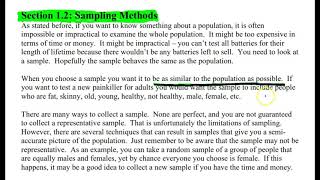
This video discusses the importance of sampling in statistics, the limitations of sampling, and the need for a representative sample to make educated guesses about a population. It emphasizes that it's often impractical or impossible to study an entire population, necessitating the use of samples. While various sampling techniques exist, none guarantee a perfectly representative sample, but they can still provide valuable insights. The video highlights the potential for sampling bias and the need to be aware of the limitations of sample data.
**2. Key Takeaways:**
* It's often impossible or impractical to study an entire population.
* Samples should aim to be as similar to the population as possible to ensure accurate results.
* No sampling method is perfect, and results are not guaranteed to be 100% accurate.
* Sampling can result in a sample that may not be representative.
* Be aware of the limitations of sampling when drawing conclusions about a population.
**3. Detailed Notes:**
* **Introduction:**
* This video focuses on how to select objects for a sample.
* Building on previous sections, which discussed the difference between a population and a sample.
* **Why Sampling is Necessary:**
* Studying the entire population is often:
* Impossible.
* Impractical (due to time and money constraints).
* Example: Testing the lifetime of every battery before selling them is impossible.
* Therefore, you need to look at a sample.
* **Characteristics of a Good Sample:**
* The sample should ideally behave like the population.
* The sample should be as similar to the population as possible.
* Example: When testing a new painkiller, sample should include:
* People of various ages (old, young).
* Different health conditions (healthy, not healthy).
* Different genders (male, female).
* Different body types (fat, skinny)
* Other relevant variables.
* **Limitations of Sampling:**
* No sampling method is perfect.
* You are not guaranteed a representative sample.
* Results in inferential statistics will not be 100% confident, but educated guesses.
* Sampling is imperfect.
* **Examples of Sampling Limitations:**
* Even with a random sample of equal males and females, the sample could, by chance, end up consisting entirely of females.
* While the probability of this is small, it's possible.
* If this happens, consider collecting a new sample if resources allow.
Related Summaries
![[캡컷PC]0015-복합클립만들기분리된영상 하나로 만들기](https://img.youtube.com/vi/qtUfil0xjCs/mqdefault.jpg)

Why this video matters
This video provides valuable insights into the topic. Our AI summary attempts to capture the core message, but for the full nuance and context, we highly recommend watching the original video from the creator.
Disclaimer: This content is an AI-generated summary of a public YouTube video. The views and opinions expressed in the original video belong to the content creator. YouTube Note is not affiliated with the video creator or YouTube.