Section0103Video1
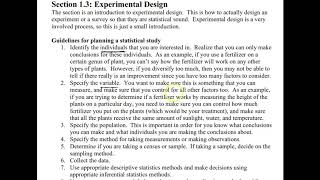
Section 1.3: Experimental Design - Notes
**Channel:** Kimberley Polly
**Video Title:** Section0103Video1
---
Summary:
This video provides a brief introduction to experimental design, focusing on the essential guidelines for planning a statistically sound study. It covers identifying individuals, specifying variables, defining the population, determining measurement methods (census vs. sample), and using appropriate statistical methods for analysis. The video emphasizes the importance of controlling factors and considering data types for choosing the right analysis techniques.
---
Key Takeaways:
* Experimental design is crucial for statistically sound studies.
* The first step is identifying the specific individuals of interest.
* Carefully specify and control the variables being measured.
* Define the population to determine the scope of conclusions.
* Decide between a census (entire population) or a sample. Samples are more common.
* Utilize appropriate descriptive and inferential statistical methods based on the data type (qualitative or quantitative).
---
Detailed Notes:
**1. Introduction to Experimental Design (0:00:0-0:00:25)**
* This section is an introduction to experimental design.
* Full courses are available on experimental design. This video covers the basics.
* The goal is to design experiments and surveys that are statistically sound.
* Experimental design is an involved process.
**2. Guidelines for Planning a Statistical Study (0:00:25-0:03:06)**
* **Identifying the Individuals (0:00:31-0:00:44)**
* Determine the specific individuals included in the study.
* Conclusions can only be made for those specific types of individuals.
* *Example:* Fertilizer on a specific plant genus; conclusions cannot be extended to other plants.
* Avoid too much diversity. This can make it difficult to identify improvement.
* **Specifying the Variable (0:01:02-0:01:21)**
* Similar to what was discussed in Section 1.1 (who and what).
* Identify a measurable variable.
* Control for all other factors.
* *Example:* Fertilizer and plant height: Control fertilizer amount (treatment), sunlight, water, and temperature.
* **Specifying the Population (0:01:48-0:01:58)**
* Define the population.
* This determines the scope of conclusions and the individuals to which the conclusions apply.
* **Specifying the Method of Taking Measurements/Making Observations (0:02:03-0:02:47)**
* Determine if a census or a sample is needed.
* Most of the time we will be using samples.
* If using a sample, use a previously learned sampling method.
* Collect the data.
* Use appropriate descriptive and inferential statistics.
* Methods used depend on the data type (qualitative or quantitative).
* **Know Any Concerns & List Recommendations (0:02:59-0:03:06)**
* List any concerns about the data collection methods.
* List recommendations for future improvements.
Related Summaries
![[캡컷PC]0015-복합클립만들기분리된영상 하나로 만들기](https://img.youtube.com/vi/qtUfil0xjCs/mqdefault.jpg)

Why this video matters
This video provides valuable insights into the topic. Our AI summary attempts to capture the core message, but for the full nuance and context, we highly recommend watching the original video from the creator.
Disclaimer: This content is an AI-generated summary of a public YouTube video. The views and opinions expressed in the original video belong to the content creator. YouTube Note is not affiliated with the video creator or YouTube.