Section0104Video1
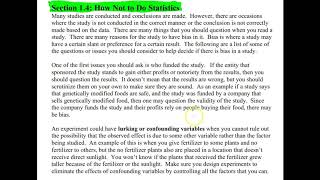
Section 1.4: How Not to Do Statistics - Note
1. Summary
This video discusses potential pitfalls in statistical studies, focusing on how biases and confounding variables can lead to inaccurate conclusions. It emphasizes the importance of critically evaluating studies by considering the funding source and controlling for extraneous factors. The video advocates for scrutinizing study results, especially when the funding source has a vested interest in the outcome. It also highlights the need to design experiments carefully to eliminate the influence of confounding variables.
2. Key Takeaways
* **Be critical of studies:** Question the study design and conclusions.
* **Funding matters:** Consider who funded the study and their potential gain from the results.
* **Scrutinize results when applicable:** Results might be biased based on financial or non-financial interests of the funding source.
* **Confounding variables:** Design experiments to control for variables that could affect results.
* **Control for variables:** The experiment must be designed to eliminate the effects of confounding variables.
3. Detailed Notes
Introduction
* Section 1.4 addresses how to identify issues in statistical studies.
* Many studies are conducted, but not all are performed or interpreted correctly.
* It is crucial to question the study design and conclusions.
* Bias can skew results, creating preferences for specific outcomes.
Bias in Studies
* **Definition:** Bias in a study means there is a slant or preference for a certain result.
* **Important Questions to Consider:**
* **Funding Source:** Who funded the study?
* If the funding entity (e.g., a company) stands to gain (profits, notoriety) from the results, the study's conclusions should be questioned.
* Example: Textbook publishers (Pearson, McGraw-Hill) may publish studies that support their own products.
* The results might not be wrong, but should be scrutinized for validity.
* Example: A study finding genetically modified foods are safe, funded by a company that sells them, may be biased.
* The funding source's goals can influence the study's conclusions.
* **Data Collection Methods**: How was the data collected? Was it done in a manner that created bias?
* How the data was collected needs to be investigated.
Confounding Variables
* **Definition:** Confounding variables are other factors that can influence the observed effect, making it difficult to isolate the variable being studied.
* **Example:**
* Plants given fertilizer may grow taller, but if they are also exposed to more sunlight than the control group, it's unclear if the growth is due to fertilizer or sunlight.
* **Solution:** Design experiments to control for confounding variables.
* Control all factors except for the variable being measured.
* Consult with experts before beginning the experiment to identify potential variables.
Related Summaries
![[캡컷PC]0015-복합클립만들기분리된영상 하나로 만들기](https://img.youtube.com/vi/qtUfil0xjCs/mqdefault.jpg)

Why this video matters
This video provides valuable insights into the topic. Our AI summary attempts to capture the core message, but for the full nuance and context, we highly recommend watching the original video from the creator.
Disclaimer: This content is an AI-generated summary of a public YouTube video. The views and opinions expressed in the original video belong to the content creator. YouTube Note is not affiliated with the video creator or YouTube.