Strength Principles Experienced on a Ship Structure
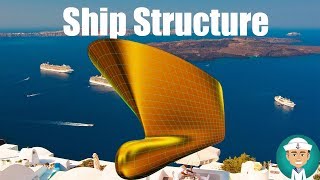
Here's a structured note based on the provided YouTube video information:
Strength Principles Experienced on a Ship Structure - Marine Online
1. Summary
This section of the Marine Online video aims to equip shipboard operational personnel with a foundational understanding of the strength principles applied to ship structures. It focuses on illustrating how hull structures behave under various stresses, using the analogy of a simple beam. The video also emphasizes the importance of recognizing potential failure modes and damages during inspections, particularly in relation to the hull girder's longitudinal strength and beam theory.
2. Key Takeaways
* **Hull Structure as a Beam:** Ship hull structures behave similarly to a simple beam when subjected to forces.
* **Understanding Stresses:** Operational personnel need to be familiar with the stresses experienced by the hull.
* **Failure Mode Recognition:** The ability to identify potential failure modes and damages during inspections is crucial for vessel integrity.
* **Longitudinal Strength:** The hull girder's ability to withstand bending forces (longitudinal strength) is a key principle, explained through beam theory.
* **Application to Ship Types:** Understanding strength principles is relevant across different ship types, considering their unique structures and critical areas.
3. Detailed Notes
#### Introduction & Learning Objectives
* **Target Audience:** Shipboard operational personnel.
* **Learning Objectives:**
* Familiarity with stresses in a hull structure (illustrated using a simple beam).
* Ability to recognize failure modes and damages during vessel inspections.
* Understanding of Hull Girder and its application of beam theory for longitudinal strength.
#### Core Concepts Illustrated
* **Strength Principles on a Ship:** This section focuses on how ships, as structures, experience and manage forces.
* **External & Internal Forces:**
* Understanding the various external forces acting on a ship's hull.
* Understanding the internal forces generated within the hull structure in response to external loads.
* **Hull Girder and Beam Theory:**
* The hull of a ship functions as a large beam.
* Beam theory is applied to explain the **Longitudinal Strength** of the hull girder. This involves understanding how the hull bends under hogging (sagging upwards) and sagging (sagging downwards) conditions.
* **Strength of Structures and Forces on Different Ship Types:**
* The specific strength requirements and forces vary significantly based on the type of ship (e.g., tanker, container ship, bulk carrier).
* Each ship type has unique structural considerations due to its purpose and cargo.
* **Anatomy and Critical Areas of Different Ship Types:**
* Identifying the key structural components (anatomy) of various ship types.
* Recognizing critical areas within these structures that are more susceptible to stress and damage.
#### Importance of Inspection and Damage Recognition
* **Inspection Protocols:** The video emphasizes the need for operational personnel to be vigilant during inspections.
* **Identifying Failure Modes:** Recognizing patterns or signs that indicate potential structural failure (e.g., cracks, deformation, corrosion).
* **Preventative Maintenance:** Early detection of damage allows for timely repairs, preventing minor issues from escalating into major structural problems.
#### Engagement & Resources
* **Call to Action:** Don't forget to subscribe to Marine Online.
* **Social Media Links:**
* Facebook: `/marineonlineyoutube`
* Twitter: `/marineonlineyou`
* Google+: `https://plus.google.com/1074502344259...`
* **Website:** `https://marineonlineyou.blogspot.com/`
Related Summaries
![[캡컷PC]0015-복합클립만들기분리된영상 하나로 만들기](https://img.youtube.com/vi/qtUfil0xjCs/mqdefault.jpg)

Why this video matters
This video provides valuable insights into the topic. Our AI summary attempts to capture the core message, but for the full nuance and context, we highly recommend watching the original video from the creator.
Disclaimer: This content is an AI-generated summary of a public YouTube video. The views and opinions expressed in the original video belong to the content creator. YouTube Note is not affiliated with the video creator or YouTube.