Strings in Python | Python Tutorial - Day #11
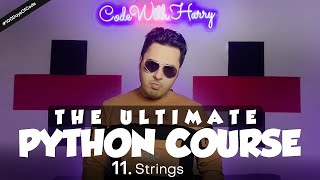
Python Tutorial - Day #11: Strings
1. Summary
This video, part of CodeWithHarry's Python tutorial series for beginners, focuses on strings in Python. It revisits the concept of strings as a fundamental data type, demonstrating different ways to define them (using single and double quotes) and exploring string indexing and multi-line strings. The video also introduces the concept of looping through strings using a 'for' loop, although loops themselves are not deeply explained at this stage.
2. Key Takeaways
* **Strings are defined using single or double quotes:** Anything enclosed within single (`'...'`) or double (`"..."`) quotes is a string in Python.
* **Strings are sequences of characters:** You can access individual characters in a string using indexing, starting from 0.
* **Multi-line strings are created using triple quotes:** Use triple single quotes (`'''...'''`) or triple double quotes (`"""..."""`) to define strings that span multiple lines.
* **String Indexing:** Strings can be indexed to access individual characters. The first character is at index 0. Attempting to access an index outside the string's length results in an "IndexError."
* **For Loops in Strings:** The for loop can be used to iterate through the characters of a string.
3. Detailed Notes
* **Introduction**
* The video is part of a 100 Days of Code challenge.
* The topic is "Strings" in Python.
* Review of what strings are (special data type).
* Strings are enclosed in double quotes (" ").
* Today's topics are:
* Different ways to create strings.
* Encouragement to follow the creator on Instagram and tag him in their challenge progress.
* **Defining Strings**
* In Python, anything enclosed in single or double quotes is a string.
* Example: `name = "Harry"` is a string.
* Example: `friend = "Rohan"` is a string.
* Example: `anotherFriend = "Lovish"` is a string.
* Single quotes can also be used: `anotherFriend = 'Lovish'`
* Quoted definition: "In python, anything that you enclose between single or double quotation marks is considered as a string."
* Quoted definition: "A string is essentially a sequence or array of textual data."
* Quoted definition: "Strings are used when working with Unicode Character"
* **String Examples and Use Cases**
* Running the code `name = "Harry"; print("Hello, " + name)` will output "Hello, Harry".
* Strings can use single quotes, as well.
* Example: Printing the phrase "He said I want to eat an apple".
* The string can use single quotes to resolve double quote errors.
* **Error Prevention**
* When including quotes inside a string defined by the same quote type (e.g., double quotes inside a double-quoted string), use escape sequences or change the string's outer quote style.
* **Multi-Line Strings**
* Problem: Creating a multi-line string using regular quotes will cause an error. The error is "EOL (End Of Line) while scanning string literal."
* Solution: Use triple single quotes (`'''...'''`) or triple double quotes (`"""..."""`) to create multi-line strings.
* Example:
```python
string = """Hello Harry
He said "Hi Harry"
Hey I am good"""
print(string)
```
* This is useful for printing blocks of text.
* **String Indexing**
* Strings are like arrays of characters.
* Each character has an index, starting from 0.
* `name = "Harry"`
* H -> index 0
* a -> index 1
* r -> index 2
* r -> index 3
* y -> index 4
* `print(name[0])` will print "H".
* `print(name[1])` will print "a".
* Attempting to access an index outside the string length will raise an "IndexError." (e.g. `name[5]`)
* **Looping Through Strings (Introduction to For Loops)**
* Problem: How to print all characters of a string without explicitly indexing them all.
* Solution: Use a 'for' loop to iterate through the string.
* Example:
```python
name = "Harry"
for character in name:
print(character, end="\n") #Prints each character on a new line
```
* This will print each character of "Harry" on a new line.
* Explanation of the for loop: A "black box" that iterates through each character.
* Note: Loops are not fully explained in this video; a future video will cover them.
* **Next Steps**
* The next video will delve deeper into strings.
* Encouragement to access the Python playlist and the related Replit code.
Related Summaries
![[캡컷PC]0015-복합클립만들기분리된영상 하나로 만들기](https://img.youtube.com/vi/qtUfil0xjCs/mqdefault.jpg)
Why this video matters
This video provides valuable insights into the topic. Our AI summary attempts to capture the core message, but for the full nuance and context, we highly recommend watching the original video from the creator.
Disclaimer: This content is an AI-generated summary of a public YouTube video. The views and opinions expressed in the original video belong to the content creator. YouTube Note is not affiliated with the video creator or YouTube.