The Rule of Nines 🔥 #RN #BSN #futurenurse
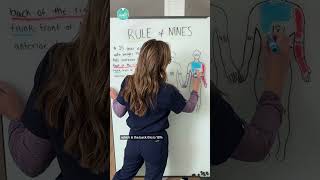
The Rule of Nines - Burn TBSA Estimation (NurseInTheMaking)
1. Summary
This video from NurseInTheMaking explains the "Rule of Nines," a critical method used in healthcare to estimate the Total Body Surface Area (TBSA) affected by burns. Understanding TBSA is crucial for determining appropriate fluid resuscitation and overall patient management in burn victims. The video breaks down how to apply the Rule of Nines to different body parts for both adults and children, emphasizing the differences in specific areas.
2. Key Takeaways
* **Purpose of the Rule of Nines:** To quickly and efficiently estimate the percentage of Total Body Surface Area (TBSA) affected by burns.
* **Importance of TBSA:** Essential for guiding fluid resuscitation, pain management, and treatment decisions for burn patients.
* **Adult vs. Pediatric Differences:** The Rule of Nines is adjusted for children, particularly regarding the head and legs.
* **Accurate Calculation is Crucial:** Incorrect TBSA estimation can lead to under or over-resuscitation, with serious consequences.
* **Beyond the Rule:** The Rule of Nines is an estimation; more precise methods may be used in complex cases.
3. Detailed Notes
#### I. Introduction to the Rule of Nines
* **What it is:** A widely used method for calculating the percentage of a person's body that has been burned.
* **Why it's important:**
* Guides **fluid resuscitation** (how much IV fluid to give).
* Helps determine the severity of the burn.
* Informs treatment strategies and prognosis.
* **TBSA (Total Body Surface Area):** The key metric calculated using the Rule of Nines.
#### II. The Rule of Nines for Adults
Each listed body part or region is assigned a specific percentage of TBSA.
* **Head and Neck:** 9%
* **Each Arm (anterior and posterior):** 9% (total 18% for both arms)
* **Anterior Trunk (chest and abdomen):** 18%
* **Posterior Trunk (back and buttocks):** 18%
* **Each Leg (anterior and posterior):** 9% (total 18% for both legs)
* **Perineum/Genitalia:** 1%
**Calculation Example (Adult):**
* Front of torso (18%) + one arm (9%) + one leg (9%) = 36% TBSA
#### III. The Rule of Nines for Children (Pediatric Considerations)
The percentages differ slightly for children due to their proportionally larger heads and smaller legs.
* **Head and Neck:** 18% (significantly larger than adults)
* **Each Arm (anterior and posterior):** 9% (same as adults)
* **Anterior Trunk:** 18% (same as adults)
* **Posterior Trunk:** 18% (same as adults)
* **Each Leg (anterior and posterior):** 6.5% (smaller than adults, totaling 13% for both)
* **Perineum/Genitalia:** 1% (same as adults)
**Adjustment for Children (if needed):**
* For children between 1 and 9 years old, subtract 0.5% from the leg percentage for each year under 9, and add that percentage to the head percentage.
* Example: A 3-year-old would have their leg percentage adjusted. (9 - 3 = 6 years. 6 * 0.5% = 3%. So, each leg would be 6.5% - 3% = 3.5%.)
#### IV. Specific Burn Scenarios & Considerations
* **Partial vs. Full Thickness:** The Rule of Nines estimates the *area* burned, not necessarily the depth of the burn, though depth is also critical for management.
* **Area of Palms:** Can be used as a rough guide; the palm of one hand (including fingers) is approximately 1% TBSA.
* **Irregularly Shaped Burns:** For smaller, scattered burns, nurses might use the Lund-Browder chart for a more precise calculation.
* **Importance of Nurses' Role:** Nurses are often the first to assess burns and apply this rule, making accurate calculation vital.
#### V. Conclusion & Resources
* The Rule of Nines is a fundamental tool for nurses and healthcare professionals dealing with burn injuries.
* **NurseInTheMaking Resources:**
* Website: [https://nurseinthemaking.co/shop](https://nurseinthemaking.co/shop)
* Complete Nursing School Bundle: [https://nurseinthemaking.co/nursingschoolbundle](https://nurseinthemaking.co/nursingschoolbundle)
* Free Guides: [https://nurseinthemaking.co/free](https://nurseinthemaking.co/free)
* **Connect with NurseInTheMaking:**
* Subscribe: [https://www.youtube.com/channel/UC_W1NUJxxzR_wABRhQ3Hzxg](https://www.youtube.com/channel/UC_W1NUJxxzR_wABRhQ3Hzxg)
* Instagram: [https://www.instagram.com/kristine_nurseinthemaking/](https://www.instagram.com/kristine_nurseinthemaking/)
* TikTok: [https://www.tiktok.com/@nurseinthemakingkristine](https://www.tiktok.com/@nurseinthemakingkristine)
Related Summaries
![[캡컷PC]0015-복합클립만들기분리된영상 하나로 만들기](https://img.youtube.com/vi/qtUfil0xjCs/mqdefault.jpg)

Why this video matters
This video provides valuable insights into the topic. Our AI summary attempts to capture the core message, but for the full nuance and context, we highly recommend watching the original video from the creator.
Disclaimer: This content is an AI-generated summary of a public YouTube video. The views and opinions expressed in the original video belong to the content creator. YouTube Note is not affiliated with the video creator or YouTube.