Type of GENE MUTATIONS: A-level Biology. Do you know the 6 types of gene mutations?
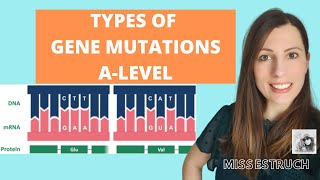
Here's a comprehensive and structured note based on the provided YouTube video information:
Gene Mutations: Types and Mutagenic Agents
1. Summary
This video from Miss Estruch's A-level Biology channel explains the different types of gene mutations. It covers six key types: addition, deletion, substitution, inversion, duplication, and translocation. The video emphasizes how changes in DNA base sequences can alter proteins and potentially lead to a variety of effects. While "duplication" isn't elaborated on in the video's explicit explanation, its definition is provided as the repetition of a DNA segment. The video also briefly mentions mutagenic agents, which cause these mutations.
2. Key Takeaways
* Gene mutations are changes in the DNA base sequence.
* There are six main types of gene mutations: addition, deletion, substitution, inversion, duplication, and translocation.
* **Substitution:** One base is replaced by another.
* **Addition:** An extra base is inserted into the DNA sequence.
* **Deletion:** A base is removed from the DNA sequence.
* **Inversion:** A section of DNA is reversed.
* **Duplication:** A section of DNA bases is duplicated.
* **Translocation:** A section of DNA moves from one chromosome to another.
* Mutations can affect the resulting protein and, consequently, the organism's traits.
3. Detailed Notes
#### A. Introduction to Gene Mutations
* **Definition:** A gene mutation is a permanent alteration in the DNA sequence that makes up a gene.
* **Significance:** These alterations can range in size from a single DNA building block (base pair) to a large segment of a chromosome. Mutations can affect a gene's ability to function.
#### B. Types of Gene Mutations
1. **Substitution Mutation:**
* **Description:** A single base is replaced by another base.
* **Example:** If the sequence is ...ATG... and it changes to ...ACG..., the thymine (T) has been substituted by cytosine (C).
* **Effect:** Depending on the specific change, this can result in a different amino acid being coded for (missense mutation), the same amino acid being coded for (silent mutation), or the premature termination of protein synthesis (nonsense mutation).
2. **Addition Mutation:**
* **Description:** One or more extra bases are added into the DNA sequence.
* **Example:** If the original sequence is ...ATG CAT G..., and an 'A' is added to become ...ATG AAT CAT G..., the sequence has changed.
* **Effect:** Addition mutations, like deletions, are frameshift mutations. They shift the "reading frame" of the genetic code, altering every amino acid sequence downstream of the mutation.
3. **Deletion Mutation:**
* **Description:** One or more bases are removed from the DNA sequence.
* **Example:** If the original sequence is ...ATG CAT G..., and a 'T' is deleted to become ...ATG CAG..., the sequence has changed.
* **Effect:** Deletion mutations are also frameshift mutations. They shift the reading frame, altering the amino acid sequence from the point of deletion onwards.
4. **Inversion Mutation:**
* **Description:** A segment of a chromosome is reversed end to end.
* **Mechanism:** A segment of DNA breaks off, flips around, and reattaches.
* **Effect:** Inversions can disrupt genes located within the inverted segment or alter gene regulation.
5. **Duplication Mutation:**
* **Description:** A section of DNA bases is duplicated within the DNA sequence.
* **Mechanism:** A segment of the DNA is repeated.
* **Effect:** Duplications can lead to an excess of gene product or provide raw material for the evolution of new genes.
6. **Translocation Mutation:**
* **Description:** A segment of DNA moves from one chromosome to another chromosome, or to a different region of the same chromosome.
* **Mechanism:** Involves the breakage and rejoining of DNA segments between non-homologous chromosomes (reciprocal translocation) or the movement of a segment from one chromosome to another without reciprocal exchange (non-reciprocal translocation).
* **Effect:** Translocations can disrupt gene function or create novel gene fusions.
#### C. Mutagenic Agents
* **Definition:** Mutagenic agents are factors that cause mutations to occur.
* **Examples (briefly mentioned or implied):**
* **Chemicals:** Such as those found in cigarette smoke.
* **Radiation:** Like UV radiation or X-rays.
* **Biological agents:** Certain viruses can also induce mutations.
#### D. Miss Estruch's Resources (Promotional Content)
* **Free Guide:** "How to analyse your tests to skyrocket your grade!" (Link provided)
* **Biology Club:** For A/A* students seeking resources, support, and community. (Link provided)
* **Free Resources:** (Link to website)
* **Bundles/Workbooks/Notes:** Various paid resources for A-level Biology are available for purchase. (Links provided)
* **Revision Videos:** Suggestion to watch entire topic videos for AQA A-level Biology.
#### E. Recommended Textbooks and Gear (Promotional Content)
* AQA A-level Biology textbook (OUP)
* CGP revision guide and workbook
* Maths skills for A-level Biology
* Synoptic essay book
* AQA A-level biology practical skills guide
* A-level Year 1 & Year 2 workbooks
* Video creation gear (iPad, pen, microphone, GoPro, etc.)
* Music credit: Soho - Riot
#### F. Disclaimer
* Links in the description may be affiliate links, meaning Miss Estruch may receive a small commission at no extra cost to the buyer.
Related Summaries
![[캡컷PC]0015-복합클립만들기분리된영상 하나로 만들기](https://img.youtube.com/vi/qtUfil0xjCs/mqdefault.jpg)
Why this video matters
This video provides valuable insights into the topic. Our AI summary attempts to capture the core message, but for the full nuance and context, we highly recommend watching the original video from the creator.
Disclaimer: This content is an AI-generated summary of a public YouTube video. The views and opinions expressed in the original video belong to the content creator. YouTube Note is not affiliated with the video creator or YouTube.