Types of Receptors: Ligand-Gated, GPCRs, Kinase-Linked & Nuclear Receptors | Pharmacology
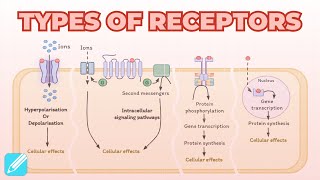
Lecture Notes: Types of Receptors - Ligand-Gated, GPCRs, Kinase-Linked & Nuclear Receptors | Pharmacology
1. Summary
This lecture, from EKG Science, details the four primary classes of drug receptor proteins: ligand-gated ion channels, G-protein-coupled receptors (GPCRs), kinase-linked and related receptors, and nuclear receptors. It explains the structure and function of each receptor type and provides illustrative examples of drugs that target them. The lecture builds upon the concept of pharmacodynamics, emphasizing receptors as crucial drug targets.
2. Key Takeaways
* Receptors are fundamental drug targets, mediating the effects of many medications.
* There are four main types of receptors:
* Ligand-Gated Ion Channels
* G-Protein-Coupled Receptors (GPCRs)
* Kinase-Linked and Related Receptors
* Nuclear Receptors
* Each receptor type has a distinct structure and mechanism of action.
* Understanding receptor types is essential for comprehending pharmacodynamics and drug action.
3. Detailed Notes
#### 0:00 Intro
* Introduction to the lecture topic: the four main types of receptor proteins.
* Connects to previous lecture on pharmacodynamics – what the drug does to the body.
* Receptors are one of the four main types of drug targets.
#### 0:35 Importance Of Receptors
* Receptors are macromolecules (usually proteins) that bind to specific signaling molecules (ligands or drugs).
* This binding initiates a cellular response.
* Receptors determine the response to a signaling molecule and thus the effects of drugs.
* The type of receptor dictates the speed of the response.
#### 3:01 Ligand-Gated Ion Channels: Structure & Function
* **Structure:** Transmembrane proteins that form an ion channel across the cell membrane.
* **Function:**
* When a ligand (e.g., neurotransmitter) binds to a specific site on the receptor, it causes a conformational change in the receptor protein.
* This change opens or closes the ion channel, altering the permeability of the cell membrane to specific ions (e.g., Na+, K+, Ca2+, Cl-).
* The flow of ions across the membrane changes the membrane potential, leading to rapid cellular responses (e.g., neuronal excitation or inhibition).
* **Speed:** Very rapid response, occurring in milliseconds.
#### 6:50 Example - Nicotinic Acetylcholine Receptors
* **Location:** Found at the neuromuscular junction and in the autonomic nervous system.
* **Ligand:** Acetylcholine (ACh).
* **Mechanism:**
* ACh binds to the nicotinic receptor, which is a ligand-gated ion channel for Na+ and K+ (and Ca2+).
* This causes depolarization of the postsynaptic membrane.
* At the neuromuscular junction, this depolarization leads to muscle contraction.
* **Drugs:**
* **Agonists:** Nicotine (mimics ACh effect).
* **Antagonists:** Curare (blocks ACh binding, leading to muscle relaxation/paralysis).
#### 11:31 G-Protein Coupled Receptors: Structure & Function
* **Structure:** Transmembrane proteins with seven transmembrane alpha-helices. They have an extracellular ligand-binding domain and an intracellular domain that interacts with G-proteins.
* **Function:**
* Ligand binding to the GPCR causes a conformational change.
* This change activates a G-protein (a heterotrimeric protein consisting of alpha, beta, and gamma subunits).
* The activated G-protein then dissociates and interacts with an effector molecule (e.g., an enzyme or ion channel).
* This interaction triggers a cascade of intracellular events, often involving second messengers (like cAMP or IP3), leading to a cellular response.
* **Speed:** Slower than ligand-gated ion channels, typically seconds to minutes.
* **Diversity:** This is the largest family of receptors in the human genome, mediating responses to a vast array of neurotransmitters, hormones, and sensory stimuli.
#### 17:59 Example - B1 Adrenergic Receptors
* **Location:** Primarily found in the heart.
* **Ligands:** Epinephrine (adrenaline) and norepinephrine (noradrenaline).
* **Mechanism:**
* Binding of epinephrine/norepinephrine to the B1 adrenergic receptor activates a stimulatory G-protein (Gs).
* The activated Gs protein stimulates adenylyl cyclase, which increases the production of cyclic AMP (cAMP).
* Increased cAMP activates protein kinase A (PKA), which phosphorylates various intracellular targets.
* In the heart, this leads to increased heart rate and contractility.
* **Drugs:**
* **Agonists:** Isoproterenol (used for bradycardia).
* **Antagonists:** Beta-blockers (e.g., Propranolol, Atenolol) – used to reduce heart rate and blood pressure in conditions like hypertension and angina.
#### 20:41 Kinase-Linked Receptors: Structure & Function
* **Structure:** These are transmembrane proteins with an extracellular ligand-binding domain and an intracellular domain that possesses enzyme activity (typically a tyrosine kinase, serine/threonine kinase, or guanylyl cyclase activity).
* **Function:**
* Ligand binding (often growth factors or hormones) causes receptor dimerization (two receptor molecules coming together).
* This dimerization activates the intracellular enzymatic domain.
* The activated enzyme catalyzes the phosphorylation of specific intracellular proteins, initiating signaling cascades (e.g., Ras-MAPK pathway).
* These pathways regulate crucial cellular processes like cell growth, differentiation, and survival.
* **Speed:** Relatively slow, hours to days, as they often regulate gene expression.
#### 25:18 Example - Epidermal Growth Factor Receptor (EGFR)
* **Location:** Found on the surface of many cell types.
* **Ligand:** Epidermal Growth Factor (EGF) and other related growth factors.
* **Mechanism:**
* EGF binding leads to EGFR dimerization and autophosphorylation of tyrosine residues on the intracellular domain.
* This recruits adapter proteins, activating downstream signaling pathways like the Ras-MAPK pathway.
* This promotes cell proliferation and survival.
* **Drugs:**
* **Tyrosine Kinase Inhibitors (TKIs):** These are a major class of anti-cancer drugs that block the activity of EGFR. Examples include Gefitinib and Erlotinib, used to treat certain types of lung cancer where EGFR mutations are present.
#### 28:28 Nuclear Receptors: Structure & Function
* **Structure:** Intracellular proteins (either in the cytoplasm or nucleus). They have a DNA-binding domain and a ligand-binding domain.
* **Function:**
* Ligands are typically lipid-soluble molecules (e.g., steroid hormones, thyroid hormones, vitamin D, retinoids) that can easily cross the cell membrane.
* Upon ligand binding, the receptor undergoes a conformational change and often translocates to the nucleus (if it wasn't already there).
* The activated receptor then binds to specific DNA sequences called hormone response elements (HREs).
* This binding modulates the transcription of target genes, either activating or repressing gene expression.
* **Speed:** Very slow response, taking hours to days, as they regulate gene expression.
#### 32:43 Example - Mineralocorticoid Receptors (Aldosterone)
* **Location:** Primarily found in the kidneys, but also in the colon, salivary glands, and brain.
* **Ligand:** Aldosterone (a steroid hormone).
* **Mechanism:**
* Aldosterone crosses the cell membrane and binds to the mineralocorticoid receptor (MR) in the cytoplasm.
* The activated MR-aldosterone complex translocates to the nucleus.
* It binds to specific HREs and increases the transcription of genes encoding ion channels and transporters.
* This leads to increased reabsorption of sodium and water, and secretion of potassium, thus regulating electrolyte balance and blood pressure.
* **Drugs:**
* **Antagonists:** Spironolactone and Eplerenone (aldosterone antagonists or MR blockers). Used to treat hypertension, heart failure, and edema by blocking the effects of aldosterone.
#### 35:00 SUMMARY
* Recap of the four receptor types:
* **Ligand-Gated Ion Channels:** Fastest response, direct ion flow (e.g., Nicotinic AChR).
* **GPCRs:** Slower, use G-proteins and second messengers for diverse effects (e.g., B1 Adrenergic R).
* **Kinase-Linked Receptors:** Regulate cell growth/survival via phosphorylation cascades (e.g., EGFR).
* **Nuclear Receptors:** Slowest, regulate gene expression by binding to DNA (e.g., Mineralocorticoid R).
* Emphasis on the importance of understanding these receptor types for pharmacology.
* Reiterates that the lecture is for educational purposes only.
---
**Lecture Source:** Ritter, J., Flower, R.J., Henderson, G., Yoon Kong Loke and Rang, H.P. (2018). Rang and Dale’s Pharmacology. 9th ed. Endinburgh: Elsevier.
Related Summaries
![[캡컷PC]0015-복합클립만들기분리된영상 하나로 만들기](https://img.youtube.com/vi/qtUfil0xjCs/mqdefault.jpg)

Why this video matters
This video provides valuable insights into the topic. Our AI summary attempts to capture the core message, but for the full nuance and context, we highly recommend watching the original video from the creator.
Disclaimer: This content is an AI-generated summary of a public YouTube video. The views and opinions expressed in the original video belong to the content creator. YouTube Note is not affiliated with the video creator or YouTube.