Types of System Calls
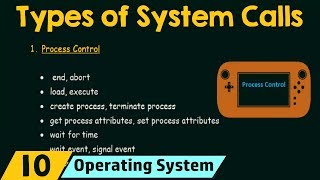
Here's a structured note based on the provided YouTube video information:
Types of System Calls (Neso Academy - Operating System)
1. Summary
This video from Neso Academy explains the fundamental concept of system calls in operating systems. It categorizes system calls into five main types: Process Control, File Manipulation, Device Manipulation, Information Maintenance, and Communications. The video aims to provide a clear understanding of how user programs interact with the operating system kernel through these system call mechanisms to perform various operations.
2. Key Takeaways
* System calls are the interface between user programs and the operating system kernel.
* They allow user programs to request services from the OS, such as process creation, file operations, and device access.
* System calls are categorized into five major types for organizational purposes.
* Each category encompasses a set of specific functions that the OS provides.
3. Detailed Notes
#### Introduction to System Calls
* **Definition:** System calls are the programmatic way in which a user program requests a service from the kernel of the operating system.
* **Purpose:** To allow user-level applications to access hardware and OS resources that are normally protected by the kernel.
* **Mechanism:** Typically invoked by a software interrupt or a special instruction.
#### Types of System Calls:
##### 1. Process Control
These system calls manage the execution and state of processes.
* **Process Creation:**
* `fork()`: Creates a new process that is a duplicate of the calling process.
* `exec()`: Replaces the current process image with a new program.
* **Process Termination:**
* `exit()`: Terminates the calling process.
* `abort()`: Terminates the calling process abnormally.
* **Process Management:**
* `wait()`: Suspends the calling process until a child process terminates.
* `signal()`: Sends a signal to a process or group of processes.
* `getpid()`: Returns the process ID of the calling process.
* `getppid()`: Returns the parent process ID.
* `getpriority()` / `setpriority()`: Get/set the scheduling priority of a process.
##### 2. File Manipulation
These system calls are used to interact with files on the file system.
* **File Creation/Deletion:**
* `create()`: Creates a new file.
* `delete()`: Deletes an existing file.
* **File Opening/Closing:**
* `open()`: Opens an existing file.
* `close()`: Closes an open file.
* **File Reading/Writing:**
* `read()`: Reads data from a file.
* `write()`: Writes data to a file.
* **File Manipulation:**
* `lseek()`: Changes the file offset.
* `stat()`: Gets file status (e.g., size, permissions).
* `chmod()`: Changes file permissions.
* `chown()`: Changes file owner.
##### 3. Device Manipulation
These system calls allow processes to interact with hardware devices.
* **Device Request/Release:**
* `request_device()`: Requests access to a specific device.
* `release_device()`: Releases a device.
* **Device Input/Output:**
* `read_device()`: Reads data from a device.
* `write_device()`: Writes data to a device.
* **Device Management:**
* `get_device_parameters()`: Retrieves device configuration.
* `set_device_parameters()`: Configures device parameters.
* `eject()`: Ejects a removable device.
##### 4. Information Maintenance
These system calls are used to get or set information about the system or processes.
* **System Information:**
* `get_current_time()`: Returns the current system time.
* `get_system_info()`: Retrieves general system information (e.g., CPU type, memory size).
* **Process Information:**
* `get_process_times()`: Returns CPU time used by a process.
* `get_process_memory_info()`: Retrieves memory usage of a process.
##### 5. Communications
These system calls facilitate communication between different processes.
* **Inter-Process Communication (IPC):**
* `pipe()`: Creates a pipe for communication.
* `shm_open()` / `shm_close()`: Manages shared memory segments.
* `msg_send()` / `msg_receive()`: For message queues.
* **Network Communications:**
* `socket()`: Creates a network socket.
* `connect()`: Establishes a connection to a remote host.
* `send()` / `recv()`: Sends/receives data over a network.
* `bind()`: Associates a socket with a port.
* `listen()`: Marks a socket as passive.
* `accept()`: Accepts an incoming connection.
---
**Follow Neso Academy on Instagram:** @nesoacademy (https://bit.ly/2XP63OE)
**Contribute:** http://bit.ly/3EpZgBD
**Memberships:** https://bit.ly/2U7YSPI
**Discord:** https://bit.ly/3HiGtJr
**WhatsApp:** https://whatsapp.com/channel/0029Va9B...
**Books:** https://bit.ly/4cZYQil
**Website:** https://www.nesoacademy.org/
**App:** https://play.google.com/store/apps/de...
**Facebook:** /nesoacademy
**Twitter [X]:** https://x.com/nesoacademy
Related Summaries
![[캡컷PC]0015-복합클립만들기분리된영상 하나로 만들기](https://img.youtube.com/vi/qtUfil0xjCs/mqdefault.jpg)

Why this video matters
This video provides valuable insights into the topic. Our AI summary attempts to capture the core message, but for the full nuance and context, we highly recommend watching the original video from the creator.
Disclaimer: This content is an AI-generated summary of a public YouTube video. The views and opinions expressed in the original video belong to the content creator. YouTube Note is not affiliated with the video creator or YouTube.