Various Possible Combinations of try catch finally in Hindi
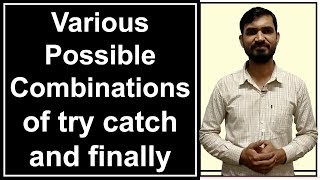
Notes on "Various Possible Combinations of try catch finally in Hindi" by Smart Programming
Summary
This video from Smart Programming provides a comprehensive explanation of Java's exception handling mechanism, focusing on the various combinations and control flow of `try`, `catch`, and `finally` blocks. The instructor, Deepak, breaks down how these blocks work together to manage errors gracefully, ensuring that critical code in the `finally` block always executes, regardless of whether an exception occurs or is caught. The video covers different scenarios, including when exceptions are thrown and caught, when exceptions are thrown but not caught, and when no exceptions occur. It also briefly touches upon printing exception information.
Key Takeaways
* **Purpose of `try-catch-finally`**: To handle runtime errors (exceptions) and ensure execution of crucial cleanup code.
* **`try` Block**: Encloses code that might throw an exception.
* **`catch` Block**: Executes only if an exception of the specified type (or a subclass) is thrown in the `try` block. It handles the exception.
* **`finally` Block**: Always executes, irrespective of whether an exception occurred in the `try` block, was caught by a `catch` block, or was not caught at all. It's ideal for resource deallocation (closing files, database connections, etc.).
* **Control Flow**: The execution path changes based on whether an exception occurs and how it's handled.
* **Combinations**: The video explores different valid arrangements and execution flows of `try`, `catch`, and `finally`.
* **Exception Information**: Demonstrates how to access and print details about the caught exception.
Detailed Notes
#### 1. Introduction to Exception Handling in Java
* **What is an Exception?**
* An event that disrupts the normal flow of program execution.
* Usually occurs due to runtime errors.
* **Purpose of Exception Handling:**
* To maintain the normal flow of the application.
* To handle runtime errors gracefully.
* To prevent program termination.
#### 2. The `try`, `catch`, and `finally` Blocks
* **`try` Block:**
* Contains the code that may potentially throw an exception.
* Syntax:
```java
try {
// code that might throw an exception
}
```
* **`catch` Block:**
* Handles a specific type of exception.
* Can have multiple `catch` blocks for different exception types.
* Syntax:
```java
catch (ExceptionType variableName) {
// code to handle the exception
}
```
* **`finally` Block:**
* Contains code that will always be executed.
* Crucial for cleanup operations.
* Syntax:
```java
finally {
// code that will always execute
}
```
#### 3. Various Combinations and Control Flow Scenarios
The video likely explores these common combinations and their execution paths:
* **Combination 1: `try` with `catch`**
* **Scenario A: Exception Occurs and is Caught**
* `try` block executes until the exception.
* Execution jumps to the matching `catch` block.
* `catch` block executes.
* Program continues after the `try-catch` structure.
* **Scenario B: No Exception Occurs**
* `try` block completes successfully.
* `catch` block is skipped.
* Program continues after the `try-catch` structure.
* **Combination 2: `try` with `finally`**
* **Scenario A: Exception Occurs (and is not caught within this block)**
* `try` block executes until the exception.
* `finally` block executes.
* The exception propagates upwards (or terminates the program if unhandled).
* **Scenario B: No Exception Occurs**
* `try` block completes successfully.
* `finally` block executes.
* Program continues after the `try-finally` structure.
* **Combination 3: `try` with `catch` and `finally`**
* **Scenario A: Exception Occurs and is Caught**
* `try` block executes until the exception.
* Matching `catch` block executes.
* `finally` block executes.
* Program continues after the `try-catch-finally` structure.
* **Scenario B: Exception Occurs (but is NOT caught by any `catch` block)**
* `try` block executes until the exception.
* `finally` block executes.
* The exception propagates upwards (or terminates the program).
* **Scenario C: No Exception Occurs**
* `try` block completes successfully.
* `catch` block is skipped.
* `finally` block executes.
* Program continues after the `try-catch-finally` structure.
* **Combination 4: `try` without `catch` or `finally`** (Not a recommended or complete structure for handling exceptions)
* If an exception occurs, the program will terminate immediately.
* **Combination 5: `try` without `catch`, but with `finally`** (Covered in Combination 2)
* **Combination 6: `try` with `catch`, but without `finally`** (Covered in Combination 1)
#### 4. Control Flow within `try-catch-finally`
* **Normal Execution:** `try` block runs to completion, `catch` is skipped, `finally` runs, program continues.
* **Exception in `try`, Caught in `catch`:** `try` runs partially, `catch` runs, `finally` runs, program continues.
* **Exception in `try`, Uncaught:** `try` runs partially, `finally` runs, exception propagates.
* **`return` statement in `try`:** `finally` still executes before the `return` value is passed back.
* **`return` statement in `catch`:** `finally` still executes before the `return` value is passed back.
* **`return` statement in `finally`:** This is generally discouraged. If `finally` returns, it can prevent the exception from propagating or a previously intended `return` from being executed. The `finally` block's return will take precedence.
* **`System.exit()` in `try` or `catch`:** The `finally` block will NOT execute if `System.exit()` is called.
#### 5. Printing Exception Information
* **`e.getMessage()`**: Returns a detail message string of the exception.
* **`e.toString()`**: Returns a string representing the exception and its detail message.
* **`e.printStackTrace()`**: Prints the throwable and its backtrace to the standard error stream. This is very useful for debugging.
#### 6. Nested `try-catch-finally`
* When a `try-catch-finally` block is inside another `try` or `catch` block.
* The inner block's execution and exception handling occur first.
* If the inner block doesn't handle an exception, it can be caught by the outer block.
* `finally` blocks execute in their respective scopes.
#### 7. Practical Applications
* **Resource Management:** Always use `finally` to close files, network connections, database connections, etc., to prevent resource leaks.
* **Graceful Error Handling:** Provide user-friendly messages instead of crashing the application.
* **Logging:** Log exceptions in the `catch` block for debugging and monitoring.
---
**Disclaimer:** These notes are based on the inferred content of the video title and description. Specific code examples and detailed explanations would be present in the actual video. The Hindi language context implies that the explanations and examples would be in Hindi, with potentially English keywords or terms used.
Related Summaries
![[캡컷PC]0015-복합클립만들기분리된영상 하나로 만들기](https://img.youtube.com/vi/qtUfil0xjCs/mqdefault.jpg)
Why this video matters
This video provides valuable insights into the topic. Our AI summary attempts to capture the core message, but for the full nuance and context, we highly recommend watching the original video from the creator.
Disclaimer: This content is an AI-generated summary of a public YouTube video. The views and opinions expressed in the original video belong to the content creator. YouTube Note is not affiliated with the video creator or YouTube.